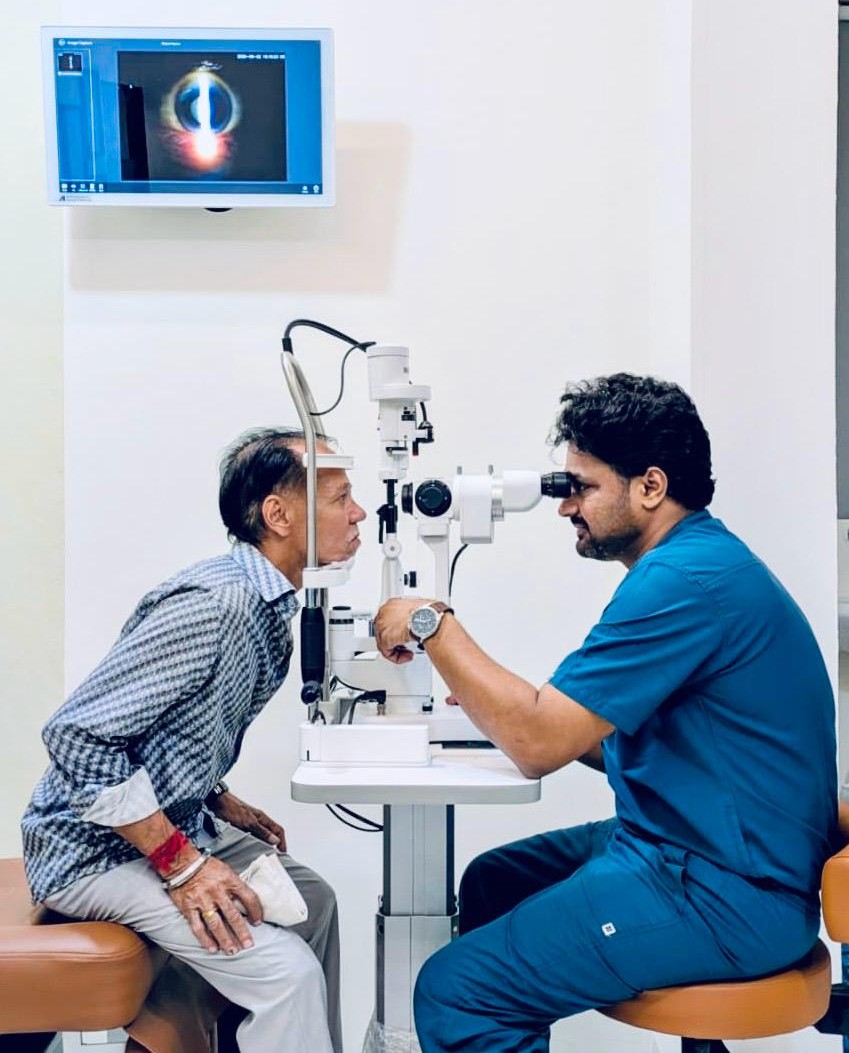
Monofocal vs Multifocal vs EDOF Lens: Which Cataract Lens Is Right for You?
Once cataract surgery is actually on your calendar, a second decision usually follows the first: which intraocular lens (IOL) do you want implanted in place of your natural lens? This isn't a minor detail — the lens you choose affects how much you'll depend on glasses afterward, and in some cases, how your night vision looks. The three main categories patients are typically offered are monofocal, multifocal, and EDOF (extended depth of focus) lenses. This guide explains how they actually differ, what trade-offs come with each, and the practical factors worth discussing with your surgeon before you decide.
Quick answer: Monofocal lenses give the sharpest vision but at one fixed distance, usually requiring reading glasses afterward. Multifocal lenses provide multiple focal points to reduce glasses dependence but can cause more glare or halos at night. EDOF lenses sit in between — extending the range of clear vision (particularly distance to intermediate) with generally fewer visual side effects than multifocal lenses, though usually with less reading-distance sharpness. The right choice depends on your lifestyle, eye health, and how much glasses-free vision matters to you.
Why the Lens Choice Matters
During cataract surgery, your
eye's clouded natural lens is removed and replaced with an artificial
intraocular lens. Unlike glasses or contact lenses, an IOL is a permanent part
of your eye — it isn't something you swap out casually afterward. Before surgery,
your surgeon uses optical biometry to measure your eye and calculate the lens
power needed to bring your vision as close as possible to your intended target,
whether that's clear distance vision, near vision, or a blend. The lens
category you choose works alongside that calculation to determine not just how
sharp your vision is, but at which distances it's sharp.
It helps to separate two
different decisions that often get discussed together: the lens power (how your
eye's specific measurements translate into a precise optical correction) and
the lens category (monofocal, multifocal, or EDOF, which determines how many
distances that correction covers well). Biometry handles the first with a high
degree of precision regardless of which category you choose; the comparison in
this guide is about the second decision — which is more a matter of trade-offs
and personal priorities than a single objectively “correct” answer.
The Three Lens Types, Explained
Monofocal Lenses
A monofocal lens has a single,
fixed focal point — typically set for clear distance vision, though it can
instead be set for near or intermediate vision depending on your needs. It's
the most established and widely used lens type, generally associated with the
sharpest contrast and clarity at its set distance, and typically produces fewer
visual side effects like glare or halos compared to multifocal designs. The
trade-off is that you'll usually need reading glasses for near tasks (if set
for distance) or distance glasses for far tasks (if set for near). Some
patients opt for “monovision,” where one eye is set for distance and the other
for near, though this takes adjustment and isn't suitable for everyone.
Multifocal Lenses
A multifocal lens has multiple
focal zones built into a single lens, aiming to provide clear vision at more
than one distance — commonly near and far, sometimes with an intermediate zone
as well. For patients who qualify and adapt well, this can meaningfully reduce
dependence on glasses for daily activities. The trade-off is a higher
likelihood of glare, halos, or starbursts around lights, particularly at night,
and some patients notice slightly reduced contrast sensitivity compared to a
monofocal lens. Multifocal lenses also generally require healthy ocular
structures beyond the lens itself — conditions like significant macular
degeneration or certain corneal irregularities can make a patient a poor
candidate.
EDOF (Extended Depth of Focus) Lenses
An EDOF lens uses a different
optical design to extend a single elongated focal zone, rather than splitting
light between distinct focal points the way a multifocal lens does. In
practice, this generally means a smoother range of clear vision from distance
through intermediate, with fewer reports of glare and halos compared to
multifocal lenses — though near vision (close-up reading) is often not as sharp
as with a true multifocal lens, and reading glasses may still be needed for
fine print. EDOF lenses are often positioned as a middle ground: more spectacle
independence than monofocal, fewer visual side effects than multifocal.
A Few Common Misconceptions
- “Premium lenses are always the better choice.” Not
necessarily — “premium” describes the added capability and cost, not a
universal upgrade. For a patient with certain retinal conditions, or someone
who strongly prioritizes the sharpest possible contrast (such as for detailed
close-up work), a monofocal lens may genuinely be the more suitable choice
despite being the standard option.
- “If I choose monofocal now, I'm stuck needing glasses
forever.” You can still get excellent, sharp vision at your chosen focal
distance — you're simply choosing to use glasses for the other distances, which
many patients are entirely comfortable with, especially if they're already used
to wearing them.
- “Multifocal and EDOF lenses guarantee I'll never need
glasses again.” Both reduce glasses dependence for many patients, but neither
guarantees total independence from glasses for every task or every patient —
outcomes vary by individual eye and healing.
A Note on Toric Lenses: If
you have significant astigmatism (an irregularly shaped cornea), any of the
three lens categories above can often be combined with toric correction —
monofocal toric, multifocal toric, or EDOF toric — to correct that astigmatism
at the same time as the cataract. This is a separate decision layered on top of
the monofocal/multifocal/EDOF choice, and your surgeon will tell you whether
it's relevant for your eyes based on your corneal measurements.
A Side-by-Side Comparison
|
Feature |
Monofocal |
Multifocal |
EDOF |
|
Vision range |
One fixed distance (usually far) |
Multiple distances (near + far, often intermediate) |
Extended range, mainly distance through intermediate |
|
Typical glasses need afterward |
Often needed for near tasks |
Reduced for most distances |
Often reduced for distance/intermediate; may still need
glasses for fine print |
|
Night glare/halos |
Lowest |
Highest |
Lower than multifocal, higher than monofocal |
|
Contrast/sharpness |
Generally sharpest |
Can be slightly reduced |
Generally good, between the other two |
|
Suitability with other eye conditions |
Widest — fewest restrictions |
More restricted (e.g. retinal/macular conditions) |
Moderately restricted |
How to Think About Which Lens Is Right for You
There's no scorecard that
produces a single right answer here — but working through these questions
before your consultation will make that conversation more productive:
?
How much do you currently rely on glasses, and how much
would you mind continuing to? Some patients are perfectly comfortable with
reading glasses; others strongly prefer not to need them.
?
Do you drive frequently at night? If so, the higher
glare/halo risk with multifocal lenses is worth weighing carefully.
?
What does your daily near-vision work actually look
like — fine print, detailed handwork, or mostly screens and casual reading?
?
Do you have any other eye conditions — macular
degeneration, significant corneal irregularity, or advanced glaucoma — that
your surgeon should factor into lens suitability?
?
What's your budget? Monofocal lenses are the standard
option; multifocal and EDOF lenses are typically categorized as premium lenses
with an associated cost difference, which is worth discussing directly during
your consultation.
Factors That May Limit Your Options
Personal preference matters, but
it isn't the only input — your eye's own health and structure can rule some
options in or out before preference even comes into play:
- Certain retinal conditions, including significant
macular degeneration, can make multifocal (and sometimes EDOF) lenses less
suitable, since these lenses depend on a healthy macula to process the split or
extended focus effectively.
- Irregular corneal astigmatism or prior corneal surgery
can affect which lenses are appropriate and how predictable the visual outcome
will be.
- Other coexisting eye conditions, such as advanced
glaucoma, may shift the priority toward a lens that preserves the clearest
possible contrast sensitivity — typically pointing toward monofocal.
- These aren't universal rules — your own surgeon's
assessment of your specific eyes is what actually determines suitability, not a
generic checklist.
What If You Change Your Mind After Surgery?
It's worth knowing upfront that
IOL exchange after surgery is possible in some cases but is a more complex
procedure than the original cataract surgery, and isn't guaranteed to be
appropriate for every situation. This is exactly why the pre-surgical conversation
about lens choice is worth taking seriously — it's meant to be a considered
decision, not a default, even though most patients do adapt well to the lens
they choose.
If both eyes need cataract
surgery, it's also worth asking your surgeon whether it makes sense to have the
same lens type in both eyes or a deliberately different combination — some
patients do well with one eye optimized for distance and the other for near,
which is a different approach from choosing a single multifocal or EDOF lens in
both eyes. This is very individual and depends on how your particular visual
system adapts.
Adjusting to a New Lens Takes Time
Whichever lens you choose, it's
normal for your brain to need a short adjustment period to get used to the new
visual input — this is particularly true for multifocal and EDOF lenses, where
the brain is learning to process multiple or extended focal information. Some
glare or haloing around lights in the first weeks after multifocal or EDOF
implantation often reduces as neuroadaptation occurs, though individual
experiences vary, and this is worth discussing with your surgeon rather than
assuming it as a permanent certainty in either direction.
How This Decision Is Handled at Sattva Eye Hospital
At Sattva Eye Hospital, optical
biometry is used to precisely measure your eye and calculate the lens power
needed for your specific situation, and lens category is discussed individually
with Dr. Ankit Ahir based on your eye's characteristics, any coexisting eye
conditions, and what you actually want your vision to prioritize day to day. If
you have a strong preference going into your consultation — for example,
wanting to minimize glasses dependence as much as possible — it's worth raising
that directly so it can be weighed against your eye's specific suitability.
About Sattva Eye Hospital in Vadodara
Sattva Eye Hospital is located
at Sthapatya, Parmeshwar Park, Nizampura Road, near Mehsana Circle, Nizampura,
Vadodara, Gujarat 390024. Clinical care is led by Dr. Ankit Ahir (MBBS, DOMS,
DNB Ophthalmology, MNAMS), with cataract surgery performed using sutureless
phacoemulsification and micro-incision cataract surgery (MICS). OPD hours are
Monday to Saturday, 11:00 AM to 8:00 PM, with Sunday reserved for emergencies.
Sattva Eye Hospital is a single,
independently owned eye hospital based in Vadodara and is not affiliated with
any other eye hospital or clinic operating under a similar name.
Conclusion
There's no single “best” lens
that applies to every patient — monofocal, multifocal, and EDOF each involve a
different balance between sharpness, visual side effects, and glasses
dependence, and the right choice depends on your specific eyes, other eye conditions,
and how you actually use your vision day to day. The most useful preparation
before your consultation is knowing these trade-offs exist, so you can have a
focused conversation about which one fits your situation rather than being
presented with the decision for the first time in the room.
If you're preparing for cataract
surgery and want to discuss which lens option fits your eyes and lifestyle,
consider scheduling a consultation with Dr. Ankit Ahir at Sattva Eye Hospital,
Vadodara, where biometry and a personalized discussion guide the decision.
FAQs
1. What's the main difference between monofocal,
multifocal, and EDOF lenses?
Monofocal lenses provide clear
vision at one fixed distance with the fewest visual side effects. Multifocal
lenses provide multiple focal points to reduce glasses dependence but carry a
higher chance of glare or halos. EDOF lenses extend a single focal range for a
middle-ground balance of spectacle independence and visual quality.
2. Will I still need glasses after cataract surgery?
It depends on the lens chosen.
Monofocal lenses typically still require glasses for some distances (often near
tasks). Multifocal and EDOF lenses are designed to reduce glasses dependence
for more activities, though needing glasses for very fine print or specific
tasks is still possible.
3. Are multifocal lenses worth the extra cost?
This depends on your priorities
and eye health. Multifocal lenses can meaningfully reduce reliance on glasses
for suitable candidates, but they carry a higher likelihood of night glare and
halos and aren't appropriate for everyone, particularly those with certain
retinal or corneal conditions. It's worth discussing the cost difference and
suitability directly with your surgeon.
4. What is an EDOF lens exactly?
EDOF stands for extended depth
of focus. Rather than splitting light between distinct focal points like a
multifocal lens, it extends a single elongated zone of clear vision, generally
offering good distance-to-intermediate vision with fewer visual side effects
than multifocal lenses, though near vision may be less sharp.
5. Can I get a toric lens if I have astigmatism?
Yes, in most cases. Toric
correction can typically be combined with monofocal, multifocal, or EDOF lenses
to address astigmatism at the same time as the cataract, depending on your
corneal measurements.
6. Who is not a good candidate for multifocal lenses?
Patients with significant
macular degeneration, certain corneal irregularities, or some other coexisting
eye conditions are often less suitable for multifocal lenses, since these
lenses depend on healthy supporting eye structures to work well. Your surgeon's
examination determines this individually.
7. Can I change my lens after cataract surgery if I don't
like it?
IOL exchange is possible in some
cases but is a more complex procedure than the original surgery and isn't
guaranteed to be appropriate for every situation, which is why lens choice is
worth carefully discussing before surgery rather than treating it as easily
reversible.
8. Does lens choice affect night driving?
It can. Monofocal lenses are
generally associated with the fewest night-vision side effects, while
multifocal lenses carry the highest likelihood of glare or halos around lights
at night; EDOF lenses typically fall in between.
9. How is the right lens power calculated for my eye?
Lens power is calculated using
optical biometry, which precisely measures your eye to determine the IOL power
needed to achieve your intended vision outcome, regardless of which lens
category you choose.
10. How do I book a consultation to discuss lens options at
Sattva Eye Hospital?
You can book an appointment
directly through Sattva Eye Hospital's website appointment page or by calling
the clinic to schedule a consultation with Dr. Ankit Ahir.