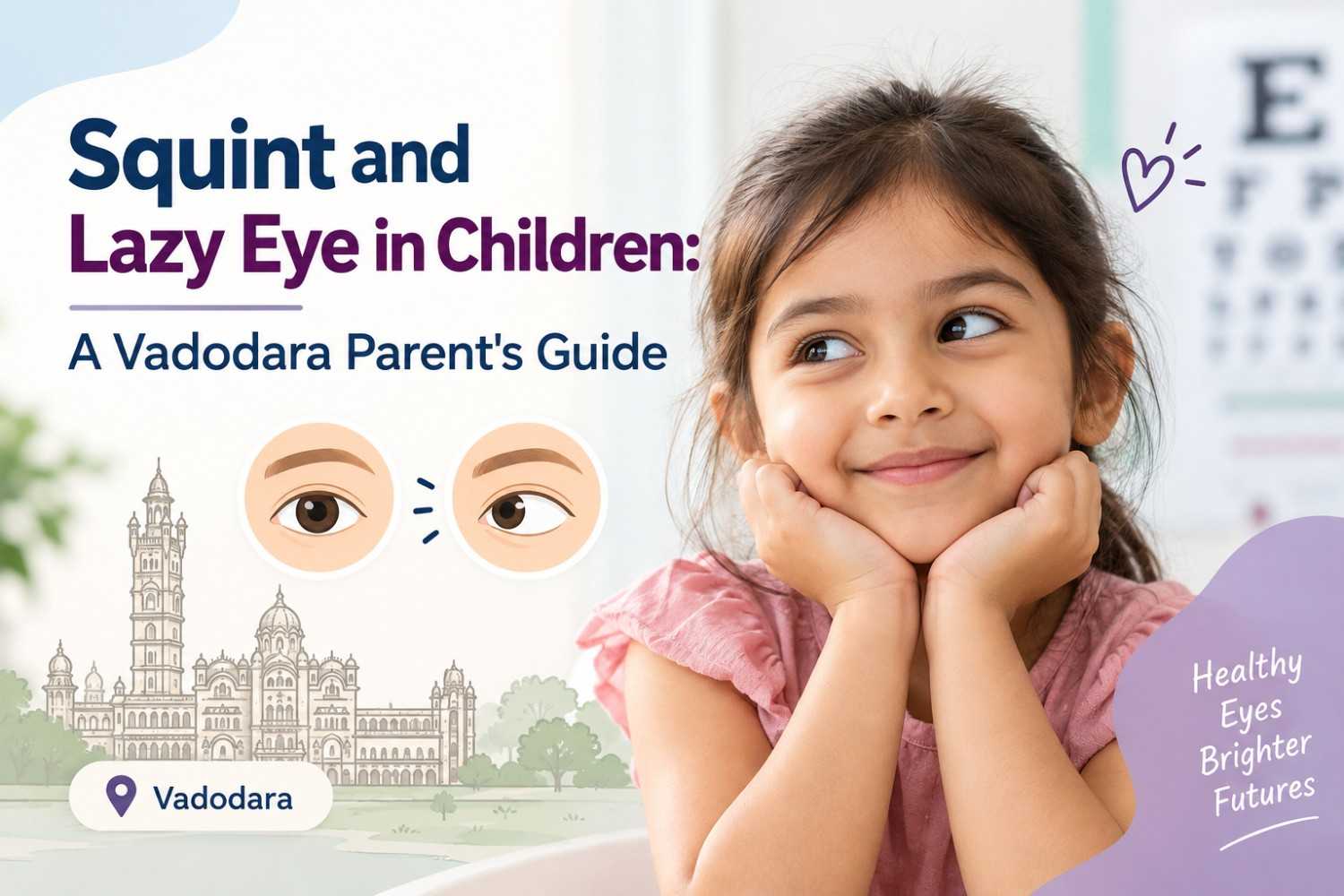
Squint and Lazy Eye Are Related, But Not the Same Thing
Squint (strabismus) is a
physical misalignment — the two eyes point in different directions instead of
working together as a team. One eye may turn inward (esotropia), outward
(exotropia), or less commonly, upward or downward.
Lazy eye (amblyopia) is
different: it is reduced vision in one eye because the brain has learned to
favour the other eye during early visual development. Amblyopia can be caused
by an untreated squint, but it can equally be caused by a significant difference
in refractive power between the two eyes, or by anything that blocks clear
vision in one eye early in life, such as a congenital cataract or a drooping
eyelid. In other words, a child can have amblyopia without ever having a
visibly crossed eye, which is exactly why relying on appearance alone can miss
the diagnosis.
How Squint and Lazy Eye Differ
|
Feature |
Squint (Strabismus) |
Lazy Eye (Amblyopia) |
|
What it
is |
Physical
misalignment of the two eyes |
Reduced
vision in one eye due to abnormal visual development |
|
Visible
to parents? |
Often
yes — one eye visibly turns |
Not
necessarily — the eyes can look perfectly straight |
|
Main
causes |
Eye
muscle imbalance, uncorrected refractive error, family history |
Untreated
squint, unequal refractive error, cataract, droopy eyelid |
|
Risk if
untreated |
Can
lead to amblyopia in the turned eye |
Permanent
reduced vision if not treated before visual development completes |
|
Typical
treatment |
Glasses,
patching, vision therapy, sometimes surgery |
Correcting
the underlying cause, plus patching or therapy to strengthen the weaker eye |
Signs Vadodara Parents Should Watch For
Because young children rarely
complain about their vision, most cases are first noticed by a parent,
grandparent, or teacher rather than the child. Watch for:
- One eye visibly turning inward, outward, upward or
downward, especially when your child is tired or concentrating on something
close
- Frequent head tilting or turning to one side while
watching TV or reading
- Closing or covering one eye in bright light, or when
trying to focus
- Squinting frequently, or holding books and devices
unusually close to the face
- Poor depth perception, such as unusual clumsiness or
difficulty catching a ball
- An abnormal or absent 'red-eye' reflection in one eye
in flash photographs, compared to the other eye
- A baby whose eyes still cross frequently or constantly
after 3 to 4 months of age
It is worth noting that a wide
nasal bridge in young children can create an illusion of crossed eyes
(pseudostrabismus) even when the eyes are correctly aligned. This is common and
harmless, but the only way to be sure is a proper eye examination rather than
assuming either way.
Why Early Treatment Makes Such a Difference
The visual pathways between the
eye and the brain are still developing throughout early childhood, and this is
the window in which the brain learns to process input from both eyes together.
If one eye consistently sends a weaker or misaligned image during this period,
the brain begins to suppress or ignore that input, and the eye's vision fails
to develop normally — even though the eye itself may be structurally healthy.
Once this developmental window closes, typically around age 7 to 8, the same
treatments become far less effective at restoring vision. This is the single
biggest reason ophthalmologists emphasise screening before school age rather
than waiting for a child to complain.
What Happens During a Child's Eye Examination
A pediatric eye evaluation is
adapted to the child's age and cooperation level, and typically includes:
- Vision assessment appropriate to age — picture charts
or matching tests for younger children, standard letter charts for older ones
- Cover testing, where each eye is covered in turn to
detect even subtle misalignment that isn't obvious to the naked eye
- Assessment of eye movements and how well both eyes work
together
- Refraction, often with the help of dilating drops in
young children, to check whether glasses are needed
- A dilated examination of the retina and internal eye
structures to rule out conditions such as congenital cataract
None of these tests require the
child to read fluently or cooperate perfectly, and pediatric eye specialists
are experienced at adapting the process for toddlers and preschoolers.
How Squint and Lazy Eye Are Treated
Treatment depends entirely on
the underlying cause and is built around two goals: correcting any refractive
error, and encouraging the brain to use the weaker eye. Common approaches
include:
- Glasses, when uncorrected refractive error is
contributing to the squint or amblyopia
- Patching therapy, covering the stronger eye for part of
the day to force the brain to rely on and strengthen the weaker eye
- Vision therapy exercises, in select cases, to improve
how the two eyes work together
- Eye muscle surgery, considered when misalignment is
significant or does not respond adequately to non-surgical treatment, aimed at
realigning the eyes so they work together comfortably
Many children need a combination
of these over time rather than a single fix, and treatment plans are typically
reviewed and adjusted every few months as the child's vision develops.
Why Choose Sattva Eye Hospital for Your Child's Eye Care in Vadodara
Pediatric eye conditions need a
specific kind of expertise — not just general ophthalmology skill, but comfort
working with young, sometimes uncooperative patients, and a trained eye for the
subtle signs of strabismus that an inexperienced examiner can miss. At Sattva
Eye Hospital, pediatric eye care is led by Dr. Ankit Ahir (MBBS, DOMS, DNB
Ophthalmology, MNAMS), who holds specialised training in strabismus management
from AIIMS, in addition to his broader ophthalmic training at the M & J
Institute of Ophthalmology, Ahmedabad, and Sri Sankaradeva Nethralaya,
Guwahati.
For parents, this means your
child's squint or lazy eye assessment is handled by a specialist with focused,
dedicated training in exactly this area, not a general checkup that treats it
as an afterthought. Consultations are structured to explain what is happening
in plain language — whether it's reassurance that a young toddler's occasional
eye crossing is normal, or a clear treatment roadmap when it isn't — so you
leave with an actual plan rather than vague advice to 'wait and watch.'
FAQ
Can lazy eye be
corrected in older children or adults?
Treatment works best before
around age 7 to 8, while the visual system is still developing, though some
improvement is occasionally possible in older children with intensive
treatment. This is why early detection, ideally before school age, makes such a
difference to the outcome.
Is squint always
visible to the naked eye?
No. Small-angle squints can be
subtle and easy to miss, especially in photographs or casual observation. A
proper eye exam using cover tests and other techniques can detect misalignment
that isn't obvious otherwise.
Does my baby's
occasional crossed eye mean strabismus?
Occasional eye crossing in the
first few months of life is common and often resolves on its own. If it
continues past 3 to 4 months of age, or is constant rather than occasional, it
should be evaluated by an eye specialist.
Will my child need
surgery for squint?
Not necessarily. Many children
are treated successfully with glasses, patching, or vision therapy alone.
Surgery is considered when misalignment is significant or does not respond
adequately to non-surgical treatment.
At what age should my
child have their first eye exam?
Vision screening is recommended between 3 and 5 years of age even without symptoms, and earlier if there is a family history of squint, lazy eye, or if any of the visible signs described in this article are noticed.