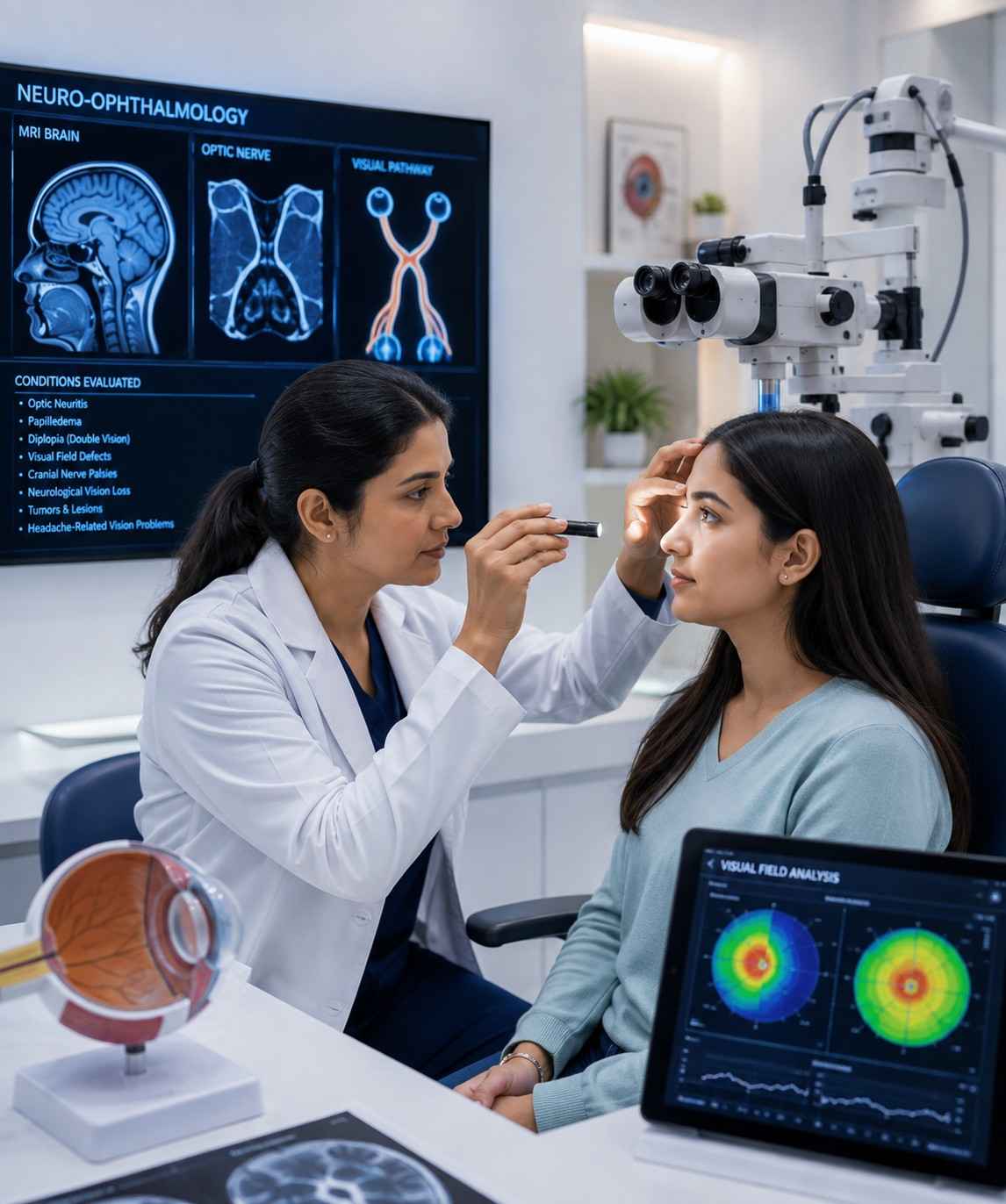
Not every vision problem starts in the eye. Clear sight depends on a working connection between your eyes, optic nerves, brain, and visual pathways — and when something along that chain is affected, it can show up as blurred or lost vision, double vision, abnormal eye movements, or visual field changes that a standard eye check does not fully explain.
At Sattva Eye Hospital in Vadodara, our neuro-ophthalmology evaluation is designed for these cases — symptoms that sit at the intersection of eye care and neurology, where getting the diagnosis right often means looking beyond the eye itself.
About the Service: Neuro-ophthalmology is a specialized area of eye care dealing with conditions involving the relationship between the eyes, optic nerves, brain, and visual pathways.
This evaluation is appropriate when vision problems cannot be fully explained by the eye alone, or when visual symptoms occur alongside a neurological condition.
At Sattva Eye Hospital, our approach combines a detailed ophthalmic examination with appropriate diagnostic testing to help identify the underlying cause and guide the next steps in your care.
Book a Neuro-Ophthalmology Evaluation in Vadodara — Get a thorough assessment for vision symptoms that do not add up.

Our neuro-ophthalmology evaluation focuses on the connection between the eyes, optic nerves, brain, and visual pathways to understand the cause of unexplained visual symptoms.
A detailed assessment helps evaluate optic nerve function, visual performance, eye movements, visual fields, and the health of the retina and optic disc.
When findings suggest a possible neurological cause, appropriate neuro-imaging and further specialist coordination may be recommended.
Our neuro-ophthalmology evaluation covers conditions affecting the optic nerve, eye movements, visual fields, and the neurological pathways responsible for vision.
Inflammation of the optic nerve that may cause vision loss, changes in color vision, or pain with eye movement.
Optic disc swelling associated with increased intracranial pressure, requiring careful evaluation for potentially serious underlying causes.
Assessment to determine whether double vision is monocular or binocular and to help localize its likely cause.
Loss of peripheral or central vision linked to conditions affecting the retina, optic nerve, or visual pathways.
Evaluation of eye movement and alignment changes that may indicate a cranial nerve disorder.
Investigation of unexplained visual changes that may originate in the optic nerve, brain, or visual pathways rather than the eye itself.
Assessment of whether visual symptoms accompanying headaches are ophthalmic, neurological, or both.
Coordinated evaluation when lesions affecting the optic nerves or chiasm are suspected as a cause of visual field changes.
Specialized evaluation, advanced diagnostic testing, and coordinated care for complex visual and neuro-ophthalmic concerns.
Assessments are guided by Dr. Ankit Ahir, MBBS, DOMS, DNB (Ophthalmology), with a structured, methodical approach to complex visual symptoms.
Optic nerve function, visual fields, eye movements, color vision, and pupillary responses are assessed together, not in isolation.
OCT imaging, visual field/perimetry testing, and detailed fundus examination support precise evaluation of optic nerve and retinal structures.
When neurological causes or papilledema are suspected, appropriate neuro-imaging and coordination with neurology are recommended.
Neuro-ophthalmic symptoms can be worrying. We take the time to explain findings and next steps in clear, easy-to-understand language.
Based in Nizampura, Sattva Eye Hospital is easily accessible for patients across Vadodara.
Our approach is designed for visual symptoms that may not be fully explained by a routine eye examination, helping us look beyond the eye when necessary.
We combine detailed functional assessment with appropriate diagnostic testing to help localize the underlying cause rather than simply documenting symptoms.
When neurological involvement is suspected, we provide clear guidance on further investigations, neuro-imaging, or specialist referral as clinically appropriate.
Our neuro-ophthalmology evaluation follows a structured approach to understand your visual symptoms, assess optic nerve and visual function, and identify when further neurological investigation may be required.
We start by understanding your visual symptoms, their onset, progression, associated features, and any relevant neurological history.
We assess how clearly you see and check color perception to identify visual changes that may indicate optic nerve or neurological involvement.
Pupillary responses and eye movements are evaluated to identify patterns that may help point toward a specific underlying cause.
Formal perimetry is used to document central and peripheral vision and identify functional visual field changes.
The optic disc, retina, and retinal blood vessels are examined in detail, with OCT imaging used when additional structural assessment is needed.
We explain the findings clearly, recommend neuro-imaging when indicated, and coordinate further management or specialist referral as needed.
Find answers to common questions about neuro-ophthalmology, optic nerve disorders, double vision, visual field problems, papilledema, optic neuritis and neuro-ophthalmology care at Sattva Eye Hospital, Vadodara.