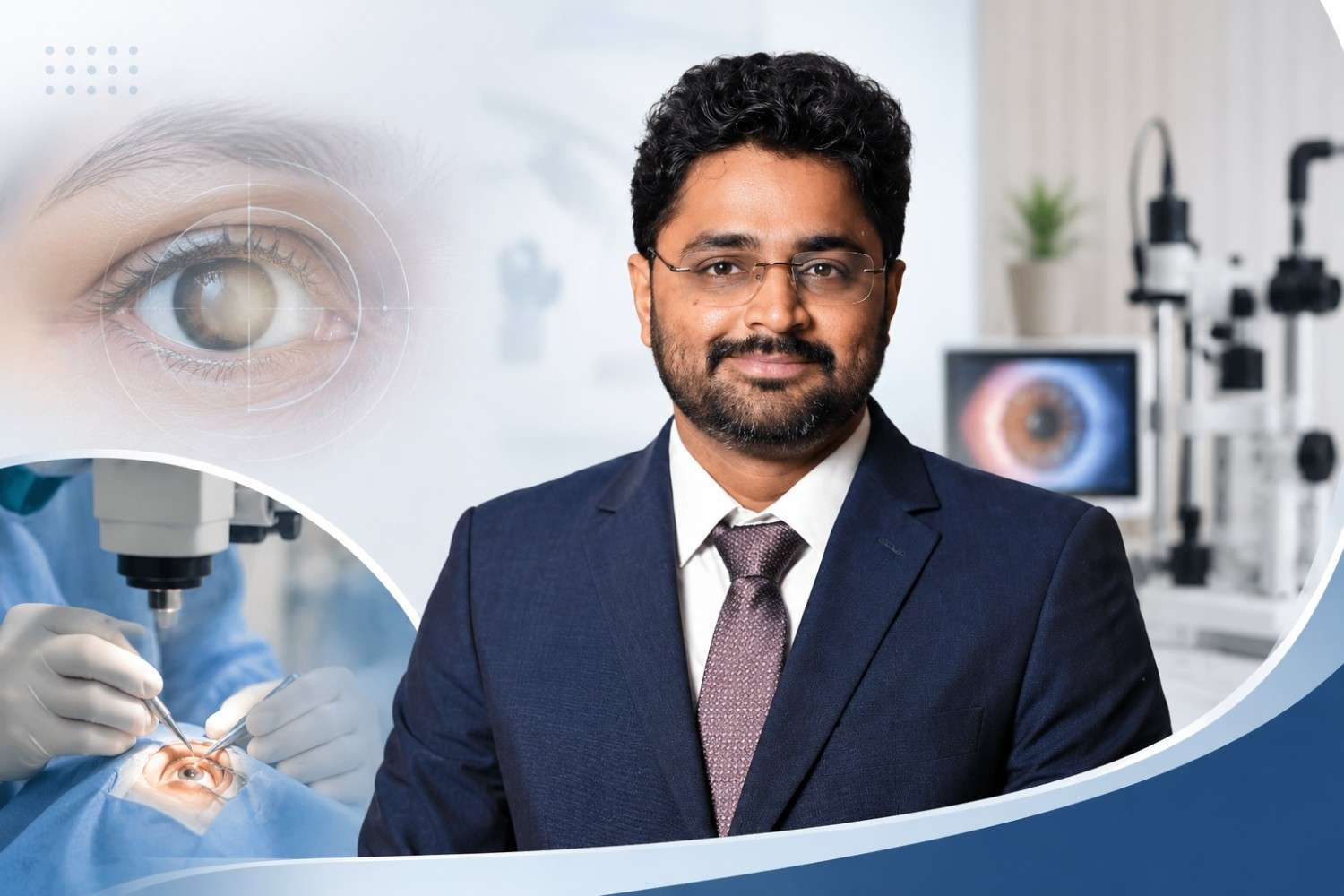
Meet Dr. Ankit Ahir: Best Cataract Surgeon in Vadodara
If you or a family member has
been told you need cataract surgery in Vadodara, one of the first things worth
doing is finding out exactly who your surgeon is and what their training looks
like — not just the hospital's name on the signboard. Dr. Ankit Ahir is the
consultant ophthalmologist and cataract surgeon leading clinical care at Sattva
Eye Hospital, Vadodara. This article walks through his qualifications, his
approach to cataract surgery, what cataracts actually are and when surgery
becomes necessary, and what a consultation at Sattva Eye Hospital typically
involves — so you have the information to make an informed decision rather than
relying on a search ranking alone.
Quick answer: Dr. Ankit Ahir is a consultant ophthalmologist and cataract surgeon
at Sattva Eye Hospital, Vadodara, holding MBBS, DOMS, DNB (Ophthalmology), and
MNAMS qualifications. He specializes in cataract and anterior segment surgery,
using sutureless phacoemulsification and micro-incision cataract surgery
(MICS), and also provides comprehensive ophthalmic care including glaucoma,
retina, pediatric, and LASIK evaluation services.
What to Look for in a Cataract Surgeon
Before getting into Dr. Ahir's
specific background, it's worth knowing what to actually check when evaluating
any cataract surgeon — in Vadodara or anywhere else.
- Postgraduate ophthalmology qualification (MS, DNB, or
DOMS) and where it was completed — training institute volume and reputation
genuinely affects hands-on surgical experience.
- Subspecialty focus — a surgeon who specifically lists
cataract and anterior segment surgery as a focus area has typically performed a
higher volume of these procedures than a general ophthalmologist covering all
areas equally.
- Surgical technique used — ask specifically whether
procedures are performed using modern phacoemulsification/MICS rather than
older large-incision methods.
- Whether biometry (precise lens power calculation) is
performed before surgery, which affects how close your outcome is to the
intended vision correction.
How clearly your diagnosis, options, and expected
outcomes are explained during the consultation itself.
Dr. Ankit Ahir's Medical Training and Qualifications
Ophthalmology in India follows a
fairly standard training pathway — an MBBS base degree, followed by a
postgraduate ophthalmology qualification, and often further subspecialty or
fellowship training. Checking where a surgeon actually trained, and for how
long, is one of the more reliable ways to gauge experience, since it's
independently verifiable rather than a marketing claim. Here's Dr. Ahir's
documented training path, as listed on Sattva Eye Hospital's official website.
Early Education and MBBS
Dr. Ahir's academic foundation
began at Sainik School Balachadi in Jamnagar, followed by an MBBS degree from
M.P. Shah Medical College, Jamnagar, Gujarat — the base medical degree required
before any specialization in ophthalmology or surgery in India.
DOMS — Postgraduate Ophthalmology Training
He completed his postgraduate
ophthalmology training (DOMS) at the M & J Institute of Ophthalmology, B.J.
Medical College, Ahmedabad — one of India's premier government eye institutes,
known for high patient volumes and rigorous surgical training.
DNB — Advanced Surgical Training
Dr. Ahir went on to gain
advanced clinical and high-volume surgical training at Sri Sankaradeva
Nethralaya, Guwahati, Assam, culminating in a DNB (Diplomate of National Board)
in Ophthalmology — a nationally recognized postgraduate qualification awarded after
supervised clinical and surgical practice.
MNAMS — National Academy of Medical Sciences
He also holds MNAMS, membership
conferred by the National Academy of Medical Sciences (India) in recognition of
academic and clinical standing — an additional, nationally recognized
credential beyond the base postgraduate qualification.
Why These Specific Qualifications Matter
For patients without a medical
background, these letters after a doctor's name can be hard to parse, but they
map to concrete milestones. DOMS confirms formal, supervised postgraduate
training specifically in ophthalmology (as opposed to a general medical degree
alone). DNB is a national-level postgraduate qualification awarded by the
National Board of Examinations after structured clinical and surgical training
and assessment — broadly equivalent in standing to an MS/MD from a university,
but administered through a separate, standardized national process. MNAMS
reflects additional recognition from the National Academy of Medical Sciences.
Taken together, they indicate a surgeon who has gone through more than one
layer of formal, externally assessed training rather than qualification through
a single route.
Dr. Ankit Ahir's Approach to Cataract Surgery
Training is only part of the
picture; how a surgeon applies that training in the operating room is what
actually affects outcomes.
Cataract procedures at Sattva
Eye Hospital are performed using sutureless phacoemulsification and
micro-incision cataract surgery (MICS) — modern techniques that use very small
incisions to break up and remove the clouded natural lens, generally associated
with faster visual recovery compared to older large-incision approaches.
Before surgery, optical biometry
is used to precisely calculate the intraocular lens (IOL) power needed for each
patient's eye — an important step for achieving the intended post-surgery
vision, since lens power needs vary from person to person.
Dr. Ahir's stated clinical
philosophy, per Sattva Eye Hospital, is to be “board-certified and deeply
passionate about restoring vision,” with a focus on “empathetic, modern, and
evidence-based eye care.” In practical terms, this means a full explanation of
the diagnosis and treatment options rather than a rushed consultation —
something worth confirming for yourself at your first visit.
A separate decision your
surgeon will discuss with you is the type of intraocular lens (IOL) used to
replace the natural lens — options generally range from standard monofocal
lenses to toric lenses (for astigmatism) and multifocal lenses, each with different
trade-offs around cost, near vs. distance vision, and suitability depending on
your eye's specific characteristics. This is a conversation to have directly
with your surgeon based on your individual eye examination, since suitability
varies by patient.
Understanding Cataracts: Symptoms, Causes, and When Surgery Is Needed
Before deciding on any surgeon,
it helps to understand the condition itself — what a cataract is, how it
develops, and when treatment actually becomes necessary. This is general
medical information and not a substitute for an in-person evaluation.
What Is a Cataract?
A cataract is a clouding of the
eye's natural lens that usually develops gradually, most often as part of the
aging process. Because the change happens slowly, many people initially dismiss
the early symptoms as “just getting older” rather than recognizing them as a
treatable eye condition.
Common Symptoms
Typical symptoms include
progressively blurred or dim vision, increased sensitivity to glare, halos
around lights (especially at night), fading or yellowing of colors, and needing
brighter light to read comfortably. These symptoms can have other causes as
well, so a clinical eye examination is needed to confirm a cataract diagnosis
rather than assuming based on symptoms alone.
Causes and Risk Factors
Age is the most common factor,
but risk is also increased by diabetes, prolonged UV exposure, smoking, certain
medications (such as long-term steroid use), previous eye injury or surgery,
and family history. Some cataracts are also present from birth or develop in
childhood, which is a separate clinical category (congenital cataract).
When Does Cataract Surgery Become Necessary?
Cataract surgery is generally
considered once the cataract starts meaningfully affecting daily life —
difficulty reading, driving (particularly at night), recognizing faces, or
performing routine tasks safely. An early-stage cataract that isn't yet significantly
affecting vision may simply be monitored. The decision of when to operate is
individual and should be made in consultation with your ophthalmologist based
on your specific findings and lifestyle needs.
Recovery and Post-Operative Care
With modern phacoemulsification
and MICS techniques, the procedure itself is typically brief and often
performed on a day-care basis, meaning most patients go home the same day. Mild
grittiness, light sensitivity, or blurred vision in the first day or two is
common as the eye settles; your surgeon will prescribe eye drops and give
specific instructions on activity restrictions (such as avoiding water exposure
or heavy lifting) during early recovery. A follow-up visit within the first day
or two, and again a few weeks later, is standard to confirm healing is on
track. Recovery timelines vary by individual, so treat any general timeline as
a starting point for discussion with your own surgeon rather than a guarantee.
Beyond Cataract Surgery: Comprehensive Eye Care
While cataract and anterior
segment surgery is Dr. Ahir's primary specialization, Sattva Eye Hospital's
clinical scope — and Dr. Ahir's documented training — extends further:
- Pediatric and squint (strabismus) care: Dr. Ahir has
completed AIIMS strabismus training (2020), reflected in the hospital's
pediatric eye care services covering childhood vision problems, congenital eye
conditions, and amblyopia.
- Rural and community eye care: Dr. Ahir contributed to
the Lifeline Express (2021), India's mobile hospital train project that brings
surgical and eye care services to underserved rural areas.
- Continuing education: Dr. Ahir holds a completed
certification in AI-driven healthcare, reflecting ongoing engagement with how
emerging technology is applied in clinical medicine.
- Broader ophthalmic services at Sattva Eye Hospital
include glaucoma evaluation and management, retinal and diabetic eye care,
oculoplasty, uvea (inflammatory eye disease) care, neuro-ophthalmology, and
LASIK evaluation and counseling — relevant if you or a family member needs a
different kind of eye care alongside or after cataract treatment, since
continuity of records with the same clinic can simplify follow-up care.
What to Expect at Your Cataract Consultation
A cataract consultation at
Sattva Eye Hospital generally follows this sequence:
1. Consultation — Dr. Ahir reviews your symptoms,
vision history, and relevant medical conditions such as diabetes.
2. Diagnostic evaluation — A clinical eye examination
confirms whether a cataract (or another condition) is present, and assesses its
severity.
3. Discussion of options — If surgery is appropriate,
the procedure, expected recovery, and intraocular lens options are explained in
plain language — monitoring rather than immediate surgery may also be
appropriate depending on severity.
4. Pre-surgical planning — If you proceed with surgery,
optical biometry is performed to calculate the correct IOL power for your eye.
5. Surgery and follow-up — Cataract surgery is
performed using phacoemulsification/MICS, followed by scheduled post-operative
checks to monitor healing and visual recovery.
Local Considerations for Cataract Surgery in Vadodara
A few practical points are worth
considering specifically because you're located in Vadodara:
- Cataract surgery typically requires at least one
post-operative check within the first day or two, plus a follow-up visit some
weeks later — choosing a surgeon whose clinic is reasonably accessible for you
reduces the risk of a missed follow-up.
- If you have diabetes, ask specifically whether your
surgeon evaluates for diabetic retinopathy alongside the cataract itself, since
both can affect the same eye and the presence of retinal disease can affect
surgical planning.
- Confirm OPD hours and how urgent post-operative
concerns (unusual pain, sudden vision change) are handled outside standard
clinic hours.
- If you're accompanying an elderly family member, ask
about the practical side too — parking or vehicle drop-off near the clinic,
wait times, and whether the day-care surgery schedule works around their other
commitments — since cataract surgery disproportionately affects older adults
for whom mobility and travel time matter more.
About Sattva Eye Hospital in Vadodara
Sattva Eye Hospital is located
at Sthapatya, Parmeshwar Park, Nizampura Road, near Mehsana Circle, Nizampura,
Vadodara, Gujarat 390024. OPD hours are Monday to Saturday, 11:00 AM to 8:00
PM, with Sunday reserved for emergencies.
Beyond cataract surgery, the
hospital's clinical services include comprehensive eye examinations, glaucoma
evaluation and management, retinal and diabetic eye care, pediatric eye care,
oculoplasty, uvea clinic services, neuro-ophthalmology, and LASIK evaluation
and counseling, supported by diagnostic facilities including OCT scanning,
optical biometry, A-B scan ultrasound, non-contact tonometry, and digital
vision testing.
Sattva Eye Hospital is a single,
independently owned eye hospital based in Vadodara and is not affiliated with,
associated with, or connected to any other eye hospital or clinic operating
under a similar name.
Conclusion
Choosing a cataract surgeon is
worth a few minutes of research: check the surgeon's postgraduate
qualifications, ask what surgical technique is used, and make sure your
questions get clear, unhurried answers at your consultation. Dr. Ankit Ahir's
training — DOMS from M & J Institute of Ophthalmology, DNB from Sri
Sankaradeva Nethralaya, and MNAMS recognition — combined with modern
phacoemulsification and MICS technique, are the kind of specifics worth
confirming for any cataract surgeon you're considering in Vadodara. None of
this replaces an in-person evaluation, but it should make that first
conversation a more informed one.
If you're experiencing blurred
vision, glare, or difficulty with night driving, or if a cataract has already
been mentioned during a routine eye exam, consider scheduling a consultation
with Dr. Ankit Ahir at Sattva Eye Hospital, Vadodara, to get a clear,
personalized evaluation of your options.
FAQs
1. Who is Dr. Ankit Ahir?
Dr. Ankit Ahir is a consultant
ophthalmologist and cataract surgeon at Sattva Eye Hospital, Vadodara, holding
MBBS, DOMS, DNB (Ophthalmology), and MNAMS qualifications, with a focus on
cataract and anterior segment surgery.
2. What cataract surgery technique does Dr. Ankit Ahir use?
Cataract procedures are
performed using sutureless phacoemulsification and micro-incision cataract
surgery (MICS), with optical biometry used beforehand to calculate the correct
intraocular lens power for each patient.
3. Where did Dr. Ankit Ahir train?
His postgraduate ophthalmology
training (DOMS) was completed at M & J Institute of Ophthalmology, B.J.
Medical College, Ahmedabad, followed by advanced surgical training (DNB) at Sri
Sankaradeva Nethralaya, Guwahati.
4. Does Dr. Ankit Ahir treat conditions other than
cataracts?
Yes. In addition to cataract and
anterior segment surgery, Sattva Eye Hospital's services under his care include
glaucoma management, retinal and diabetic eye care, pediatric eye care,
oculoplasty, uvea clinic services, neuro-ophthalmology, and LASIK evaluation.
5. What are the early symptoms of a cataract?
Common early symptoms include
gradually blurred or dim vision, glare or halos around lights, fading colors,
and needing brighter light to read — though these symptoms can have other
causes, so a clinical exam is needed to confirm a cataract.
6. When is cataract surgery actually necessary?
Surgery is generally considered
once the cataract starts meaningfully affecting daily activities like reading,
driving, or recognizing faces. An early-stage cataract that isn't significantly
affecting vision may simply be monitored rather than operated on immediately.
7. Is cataract surgery painful?
Cataract surgery is typically
performed under local or topical anesthesia and most patients report minimal
discomfort during the procedure itself; some mild irritation during recovery is
common, but you should discuss your specific expectations and any concerns
directly with your surgeon.
8. How long does recovery take after cataract surgery?
Initial visual recovery with
modern phacoemulsification/MICS techniques is often noticeable within a few
days, though full healing and stabilization of vision can take several weeks;
your surgeon will give you a recovery timeline specific to your case at your
pre-surgical consultation.
9. Does having diabetes affect cataract surgery?
Diabetes can affect both
cataract development and surgical planning, particularly if diabetic
retinopathy is also present, so it's important to mention your diabetes history
and have your retina evaluated alongside the cataract itself.
10. How do I book a consultation with Dr. Ankit Ahir at
Sattva Eye Hospital?
You can book an appointment
directly through Sattva Eye Hospital's website appointment page or by calling
the clinic to schedule a consultation at a convenient time.