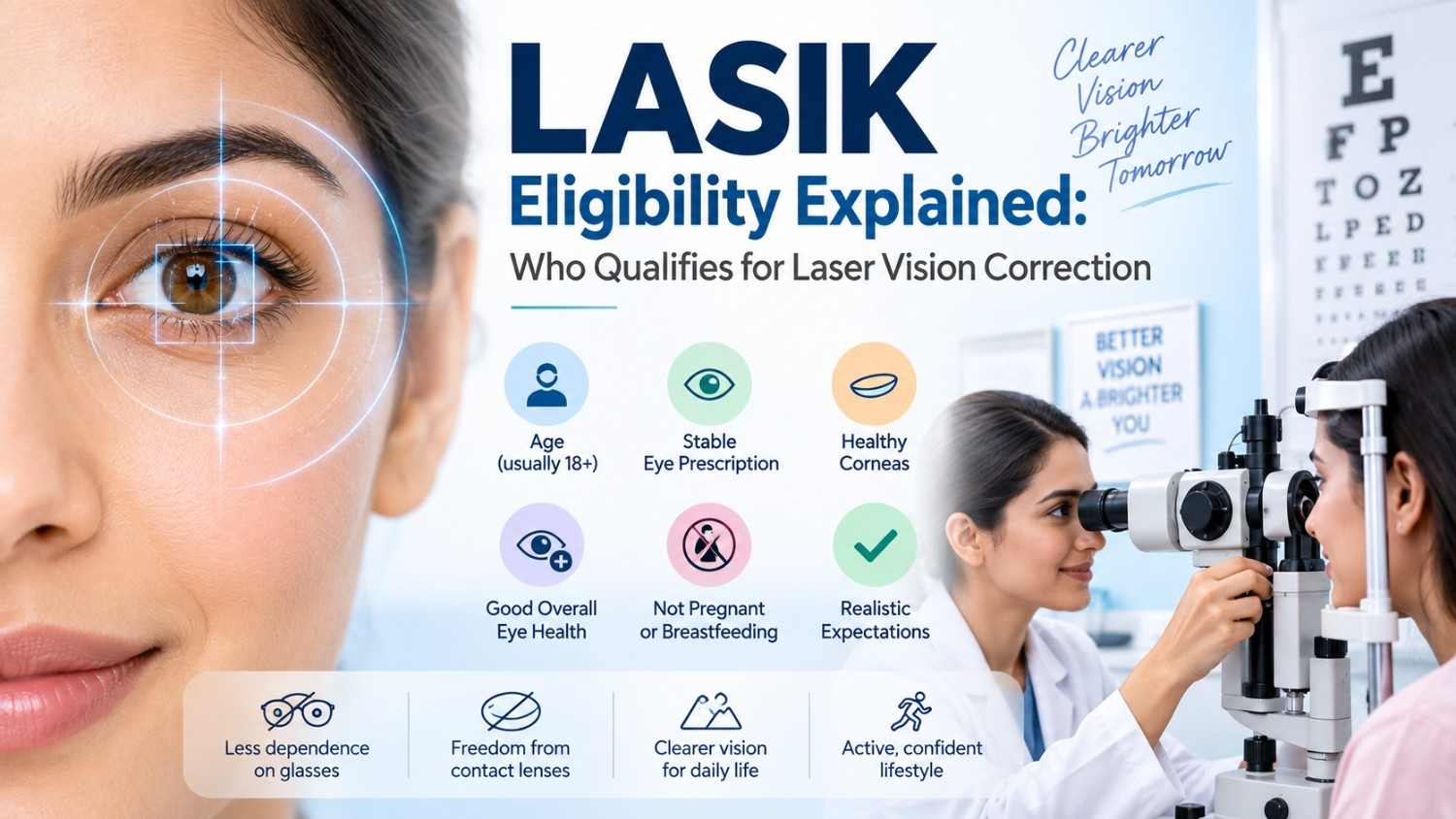
LASIK Eligibility Explained: Who Qualifies for Laser Vision Correction
If you have spent years reaching for
your glasses before your feet hit the floor, the question is a fair one: could
laser vision correction work for me?
Here is the honest answer. Wearing
glasses or contact lenses makes you a candidate for assessment — not
automatically a candidate for surgery. LASIK eligibility is decided by a
detailed eye examination, and it depends on how stable your prescription has
been, the thickness and shape of your cornea, the health of your tear film and
eye surface, your general medical history, and whether your expectations match
what the procedure can realistically deliver. Some people are ruled out. Many
are suitable. A fair number are suitable for a different laser or
lens-based procedure than the one they walked in asking about.
This guide explains what an
ophthalmologist actually looks at when deciding whether you qualify for LASIK,
what commonly disqualifies people, and what your options are if the answer
turns out to be no.
What Is LASIK Eye Surgery?
LASIK stands for Laser-Assisted In Situ Keratomileusis. In
plain language: a thin flap is created in the surface of the cornea — the clear
front window of the eye — and an excimer laser reshapes the tissue underneath
so that light focuses more accurately on the retina. The flap is then
repositioned.
Reshaping the cornea changes its focusing power, which is why laser
vision correction can address common refractive errors: myopia
(short-sightedness, where distance vision is blurred), hyperopia
(long-sightedness), and astigmatism (blur or distortion caused by an
irregularly curved cornea).
People consider LASIK for practical reasons more than cosmetic ones
— sport, swimming, shift work, monsoon-season fogged lenses, contact lens
intolerance, or simply not wanting to depend on a pair of spectacles. Those are
all reasonable motivations. None of them, on their own, make someone eligible.
LASIK is elective surgery on a healthy, functioning eye, and that is precisely
why the screening is so thorough.
Who Is Usually Eligible for LASIK?
The factors below are the ones most commonly assessed. Treat them as
a guide to the conversation you will have with your ophthalmologist, not as a
scorecard.
Age and Eye Maturity
LASIK is generally
considered in adults. Laser systems are approved for adult use, with the
minimum age specified in device labelling — commonly 18 or 21 years depending
on the platform — and the underlying reason is biological rather than
bureaucratic: the eyes of teenagers and young adults are often still changing.
Correcting a prescription that has not finished moving simply means it moves
again afterwards.
A Stable Glasses or Contact Lens Prescription
This
is one of the most important criteria and one of the easiest to check. The US
Food and Drug Administration describes needing a change in your glasses or
contact lens prescription within the past year as refractive instability,
and treats it as a reason you are probably not a good candidate. Most surgeons
want to see a prescription that has held reasonably steady for at least twelve
months before proceeding. Bring your old spectacle prescriptions to your
consultation — they are genuinely useful evidence.
Healthy Corneas with a Regular Shape
Because
LASIK works by reshaping the cornea, the cornea has to start out structurally
sound and regularly shaped. Corneal mapping is used to look for irregular
patterns that may indicate keratoconus or a cornea at risk of thinning and
bulging after surgery. This is the single most important safety screen in
refractive surgery.
Adequate Corneal Thickness
Laser
correction removes a small amount of corneal tissue — more tissue for a higher
prescription. Enough cornea must remain afterwards for the eye to stay
structurally stable. Device labelling commonly specifies a minimum residual
thickness beneath the flap, with 250 microns appearing in FDA-approved LASIK
labelling as a floor, and many surgeons work to a more conservative margin than
that. Thinner corneas, or higher prescriptions, reduce the room available.
Good Overall Eye Health
Conditions such
as significant cataract, advanced glaucoma, active corneal infection or
inflammation, retinal disease, or recurrent corneal erosion need to be
identified and addressed first. Some of these are permanent reasons to avoid
LASIK; others simply need treating or stabilising before the question is
revisited.
A Manageable Ocular Surface
A healthy
tear film matters more than most patients expect. LASIK temporarily reduces
corneal nerve sensitivity, which can worsen dry eye for a period afterwards.
Mild dryness is often treatable beforehand. Severe dry eye disease appears in
FDA-approved LASIK labelling as a contraindication.
A Refractive Error Within Treatable Range
Each
laser platform is approved to treat a defined range of myopia, hyperopia and
astigmatism. Very high prescriptions may fall outside that range, or may
require removing more tissue than your cornea can safely spare. The FDA also
notes that results are generally less predictable in patients with very large
refractive errors of any type.
Realistic Expectations
This one is not a
test result, but it is a genuine eligibility factor. LASIK aims to reduce
dependence on glasses; it does not guarantee that you will never need them for
any task at any age. A patient who expects a perfect, permanent, risk-free
outcome is not well matched to the procedure, no matter how good their corneal
scan looks.
Who May Not Be a Good Candidate for LASIK?
Common reasons an ophthalmologist may advise against LASIK, or
postpone the decision:
•
A prescription that has changed
within the past year
•
Keratoconus, suspected
keratoconus, or other irregular corneal findings on topography
•
Insufficient corneal thickness
for the correction required
•
Severe or poorly controlled dry
eye disease
•
Recurrent corneal erosion
•
Advanced glaucoma, or
significant cataract or retinal disease
•
Autoimmune, collagen vascular,
or immunodeficiency conditions, which appear as contraindications in approved
LASIK labelling
•
Uncontrolled diabetes, which
can itself destabilise the prescription
•
Pregnancy and breastfeeding
•
Certain medications that affect
healing or the ocular surface
•
Contact sports or occupations
involving a significant risk of blows to the eye, where a flap-based procedure
may not be the best structural choice
•
Expectations that cannot be met
One thing deserves emphasis, because it is where most articles stop
and most patients start worrying. “Not suitable for LASIK” is not the same
as “no options.” It very often means a different procedure, or the same
question revisited after a treatable issue is managed.
How Doctors Check LASIK Eligibility
A LASIK evaluation is more detailed than a routine eye test, because
it has to assess not just what your vision is, but what your cornea will
tolerate. Exactly which tests are performed varies between practices and
clinical findings, but an assessment commonly includes:
•
Refraction — precise measurement of your current prescription, sometimes
repeated after dilating drops
•
Visual acuity testing — how clearly you see, with and without correction
•
Corneal topography or
tomography — detailed mapping of the corneal
surface to detect irregularity
•
Corneal thickness
measurement (pachymetry) — to calculate how much
tissue can safely be reshaped
•
Tear film and ocular surface
assessment — to identify dry eye that should be
treated first
•
Pupil assessment, where clinically relevant to the planned treatment zone
•
Slit-lamp examination and a
dilated retinal check — general eye health, front
to back
•
Medical, medication and
contact lens history
•
A structured conversation
about your visual goals, occupation and lifestyle
Why you will be
asked to stop wearing contact lenses first
Contact
lenses temporarily mould the cornea, and a moulded cornea produces measurements
that do not reflect its true shape. Because the entire eligibility decision
rests on those measurements, you will be asked to switch to glasses beforehand.
The FDA’s patient guidance advises stopping soft lenses for at least two weeks
before the initial evaluation, rigid gas permeable lenses for at least three
weeks, and hard PMMA lenses for at least four weeks. Your ophthalmologist will
give you a timeframe based on your lens type and how long you have worn them —
follow it, because turning up in contacts usually means the appointment has to
be repeated.
Can You Have LASIK If You Have…
High Myopia
Possibly, but it depends on
the arithmetic of your cornea. Higher corrections require more tissue removal,
so high myopia combined with an average or thin cornea may leave too little
residual thickness. Where LASIK is not safe, other refractive options —
including lens-based procedures such as phakic intraocular lenses — may be
discussed for suitable patients.
Astigmatism
Yes, frequently. Astigmatism
is routinely treated with laser vision correction within approved ranges. Very
high or irregular astigmatism needs closer assessment, because irregularity can
point to an underlying corneal problem rather than a simple focusing error.
Dry Eyes
It depends on severity. Mild to
moderate dryness is often treated and re-assessed rather than treated as a
permanent bar. Severe dry eye disease is a labelled contraindication, and
proceeding anyway risks a genuinely miserable recovery. If you already rely on
lubricating drops several times a day, mention it at your first visit.
Thin Corneas
Thin corneas do not
automatically rule out laser correction, but they narrow the options. Surface
procedures such as PRK, which do not create a flap, are sometimes considered
where corneal thickness is marginal for LASIK. The decision rests on the combination
of thickness, shape and prescription — not thickness alone.
Diabetes
Well-controlled diabetes does
not automatically exclude you, but it is assessed carefully. Blood sugar
fluctuations can shift your refraction, which undermines the stability
requirement, and diabetic eye disease must be ruled out. Uncontrolled diabetes
appears as a contraindication in approved LASIK labelling.
Pregnancy or Breastfeeding
This is a
postponement rather than a permanent exclusion. Hormonal changes can
temporarily alter your prescription and your tear film, and pregnant or nursing
women are listed as contraindicated in FDA-approved LASIK labelling. The usual
advice is to wait until after breastfeeding has stopped and the prescription
has settled.
Keratoconus
Keratoconus — progressive
thinning and bulging of the cornea into a cone shape — is a contraindication to
LASIK, as is a keratoconus-suspect topography pattern. Reshaping an already
weakened cornea can accelerate the problem. Patients with keratoconus are
managed along a different pathway entirely, which may include specialised
contact lenses or corneal cross-linking depending on the stage. This is exactly
what corneal topography exists to catch.
Previous Eye Surgery
Not necessarily a
bar, but it changes the assessment substantially. Previous refractive surgery,
corneal surgery, squint surgery or retinal treatment all affect the
calculations and the structural picture. Bring your operative records.
Is There an Age Limit for LASIK?
There is a minimum, and there is no fixed maximum.
At the lower end, LASIK is an adult procedure. Laser platforms
specify a minimum age in their approval labelling — commonly 18 or 21 years —
and the clinical reasoning is prescription stability rather than the birthday
itself. A 19-year-old whose power has shifted twice in two years is not a good
candidate; a 22-year-old with three years of unchanged prescriptions may well
be.
At the upper end, age alone does not disqualify anyone. What changes
with age is the surrounding picture. From the early forties onwards, presbyopia
— age-related difficulty focusing on near objects — develops in everyone, and
correcting distance vision with LASIK does not prevent it. Someone who has
LASIK at 45 may still need reading glasses, and should know that before, not
after. Later still, if a cataract is developing, cataract surgery with a
carefully chosen intraocular lens may address the refractive error more
sensibly than laser correction would.
What If You Are Not Eligible for LASIK?
Being told no to LASIK is not being told no to better vision.
Depending on the reason, your ophthalmologist may discuss:
•
Updated glasses or contact
lenses, including options you may not have tried
•
Treating the obstacle first — managing dry eye, stabilising diabetes, waiting out pregnancy —
and reassessing
•
PRK (photorefractive
keratectomy), a surface laser procedure with no
corneal flap, sometimes considered for thinner or structurally marginal corneas
•
SMILE (small incision
lenticule extraction), a flap-free laser technique
used for selected prescriptions
•
Phakic intraocular lenses, where a lens is implanted without removing the natural lens,
sometimes considered for very high prescriptions
•
Refractive lens exchange or
cataract surgery with a premium IOL, where age and
lens changes make that the more logical route
How the main laser options differ
|
|
LASIK |
PRK |
SMILE |
|
Corneal
flap |
Yes |
No —
surface layer removed and regrows |
No —
small incision only |
|
Typical
visual recovery |
Fast,
often within days |
Slower,
usually over one to several weeks |
Fast,
generally similar to LASIK |
|
Post-operative
discomfort |
Usually
minimal |
More
significant in the first few days |
Usually
minimal |
|
Often
considered when |
Cornea
is of adequate thickness and regular shape |
Cornea
is thinner, or flap creation is undesirable |
Selected
myopia and astigmatism, flap-free preferred |
|
Relevant
for contact-sport or high-impact occupations |
Flap
raises structural considerations |
No
flap |
No
flap |
No
procedure on this table is universally better. Suitability depends on your
corneal measurements, prescription, ocular surface and occupation — which is
the whole purpose of the evaluation.
What Happens During a LASIK Consultation?
1.
Medical and eye history. Existing conditions, medications, previous surgery, family history
of corneal disease, and how long you have worn contact lenses.
2.
Vision measurement. Visual acuity and a precise refraction, sometimes repeated with
dilating drops for accuracy.
3.
Corneal mapping and
measurement. Topography to assess shape and
regularity; thickness measurement to calculate what can safely be treated.
4.
Ocular surface evaluation. Tear film quality and any dry eye that needs managing first.
5.
Full eye health examination. Slit-lamp assessment of the front of the eye and a dilated
examination of the retina and optic nerve.
6.
Discussion of goals, options
and risks. What you want from the procedure, what
is realistically achievable, and what the alternatives are.
7.
A personalised candidacy
decision — including, where appropriate, a clear
recommendation against proceeding.
At Sattva Eye Hospital in Vadodara, the LASIK evaluation and
counselling process
is built around exactly this sequence: assessment of your refractive error,
corneal shape and regularity, ocular surface, general eye health and medical
history, followed by an honest discussion of what is and is not suitable for
your eyes.
Considering laser vision correction? Book a LASIK
evaluation in Vadodara and get a clear answer based on your own measurements.
Questions to Ask Before LASIK
Take these to your consultation:
•
Based on my measurements, am I
a suitable candidate for LASIK?
•
Has my prescription been stable
enough?
•
What did my corneal topography
show, and is my corneal thickness adequate for the correction I need?
•
Do I have dry eye or any other
ocular surface issue that should be treated first?
•
Which procedure do you
recommend for my eyes, and why that one rather than the alternatives?
•
What risks are most relevant to
my eyes specifically?
•
Am I likely to still need
glasses for some tasks — night driving, or reading as I get older?
•
How will presbyopia affect my
result over the next ten years?
•
What does the follow-up
schedule look like?
•
If I am not suitable, what
would you suggest instead?
Why Patients Choose Sattva Eye Hospital for LASIK Evaluation in Vadodara
LASIK candidacy assessment at Sattva Eye Hospital is led by Dr. Ankit
Ahir (MBBS, DOMS, DNB Ophthalmology, MNAMS), a cataract and anterior
segment surgeon and comprehensive ophthalmologist. He completed postgraduate
ophthalmology training at the M & J Institute of Ophthalmology, B.J.
Medical College, Ahmedabad, and advanced clinical training at Sri Sankaradeva Nethralaya,
Guwahati, and is a Member of the National Academy of Medical Sciences (India).
That background matters here for a specific reason. Refractive
counselling is a corneal and anterior segment decision, and the value of the
consultation lies as much in a well-judged “not for you” as in a green light.
The hospital’s refractive service is explicitly built on honest counselling
rather than a default recommendation — your corneal health, the type of
refractive error, your lifestyle and your visual goals decide the advice, not a
standard package.
The LASIK evaluation also sits alongside a broader eye health
assessment rather than being treated as a standalone measurement exercise,
which is how conditions that would affect the outcome get picked up in the
first place.
Sattva Eye Hospital, Nizampura, Vadodara. Appointments: +91 75760
82474.
Final Takeaway
LASIK eligibility is individual. It is not determined by how strong
your glasses are, how long you have worn them, or how much you want to be rid
of them. It is determined by measurable things — prescription stability,
corneal thickness and shape, ocular surface health, general eye and medical
health — and by whether the outcome you are hoping for is the outcome the
procedure can deliver.
Wearing glasses does not qualify you. Being told LASIK is unsuitable
does not disqualify you from better vision, because other procedures exist for
other corneas. And the only way to find out which category you fall into is a
proper laser vision correction assessment with a qualified ophthalmologist.
Book your LASIK evaluation and counselling
consultation at Sattva Eye
Hospital, Nizampura, Vadodara, or call +91 75760 82474 to schedule a
comprehensive eye examination.
FAQ
What is the minimum age for LASIK?
LASIK is an adult procedure, with
minimum ages of 18 or 21 specified in laser device approvals depending on the
platform. The reason is prescription stability rather than the age itself — a
young adult whose power is still changing is unlikely to be advised to proceed
regardless of birthday.
How stable should my prescription be
before LASIK?
Generally stable for at least a year. The
FDA describes a change in your glasses or contact lens prescription within the
past year as refractive instability and a reason you are probably not a good
candidate. Older prescription records help your ophthalmologist confirm this.
Can people with astigmatism get LASIK?
Often, yes. Astigmatism within approved
treatment ranges is routinely corrected with laser vision correction. Very high
or irregular astigmatism requires more careful assessment, as irregularity may
indicate an underlying corneal condition.
Can thin corneas prevent LASIK?
They can. Laser correction removes
corneal tissue, and enough must remain for the eye to stay structurally stable.
Where the margin is too tight for LASIK, a surface procedure such as PRK may be
considered instead. The decision depends on thickness, corneal shape and the
size of the correction together.
Can dry eye affect LASIK eligibility?
Yes. Mild to moderate dry eye is usually
treated and reassessed rather than being a permanent bar. Severe dry eye
disease is listed as a contraindication in approved LASIK labelling, partly
because the procedure can worsen dryness for a period afterwards.
Can LASIK correct high power?
Within limits. Each laser platform is
approved for a defined range, and higher corrections require removing more
tissue, which some corneas cannot safely spare. The FDA also notes that results
are generally less predictable in patients with very large refractive errors.
Where LASIK is unsuitable, lens-based options may be discussed.
Can I have LASIK if I have diabetes?
Well-controlled
diabetes does not automatically rule it out, but it needs careful assessment —
blood sugar fluctuations can shift your prescription, and diabetic retinal
disease must be excluded. Uncontrolled diabetes is a labelled contraindication.
Can I have LASIK during pregnancy?
LASIK is not performed during pregnancy
or breastfeeding; pregnant and nursing women are listed as contraindicated in
approved LASIK labelling. Hormonal changes can also temporarily alter both
prescription and tear film. It is a postponement, not a permanent exclusion.
What happens if I am not eligible for
LASIK?
Your ophthalmologist will explain why and discuss the alternatives, which may include treating a reversible obstacle and reassessing, a surface laser procedure such as PRK, a flap-free option such as SMILE, lens-based surgery for very high prescriptions, or optimised glasses and contact lenses.