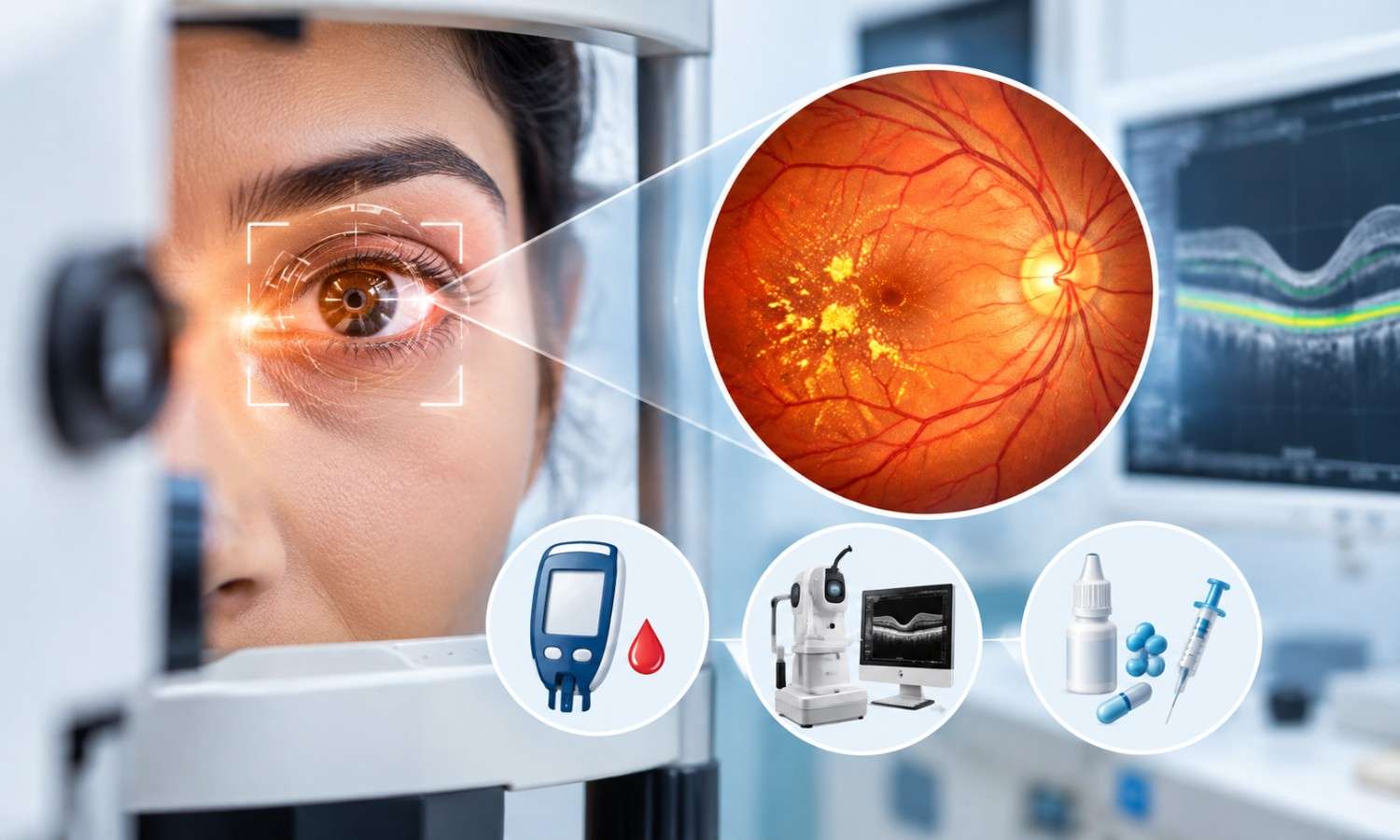
Diabetic Retinopathy: Symptoms, Tests and Treatment Options
|
Quick
answer: Early diabetic retinopathy usually causes no
symptoms. It is found through a dilated eye examination or retinal imaging,
not by checking how well you see. Treatment depends on the stage and on
whether the macula is swollen, and ranges from regular monitoring to
injections, laser or surgery. Sudden changes in vision need urgent
assessment. |
Diabetes can
slowly damage the tiny blood vessels that supply the retina, the light-sensing
layer at the back of the eye. This is called diabetic retinopathy, and in its
early stages it often causes no change in vision. An eye can look and feel fine
while the retina is already changing, which is why people with diabetes are
advised to have regular dilated eye examinations even when they see well.
This guide
covers symptoms, screening and diagnosis, stages, treatment options, and when a
change in vision is urgent. If you live in Vadodara, it also explains what to
expect from a diabetic eye examination. It is general education and cannot
diagnose your eyes or tell you which treatment you need.
What Is Diabetic Retinopathy?
The retina is a
thin layer of light-sensitive tissue at the back of each eye. Its central area,
the macula, handles sharp, detailed vision such as reading and recognising
faces.
When blood
sugar stays high for years, it can damage the retina's small blood vessels.
They may leak fluid or blood, or become blocked so that parts of the retina are
starved of blood. In advanced disease, the retina grows new, fragile vessels
that bleed easily and can form scar tissue.
Diabetes also
raises the risk of cataract and glaucoma, so a diabetic eye check looks at more
than the retina. Diabetic macular edema (DME), which is swelling of the macula,
is a complication that doctors discuss separately because it can affect central
vision at any stage.
Risk rises with
a longer duration of diabetes, high blood sugar, high blood pressure and high
cholesterol, and with pregnancy in a woman who already has diabetes. In India
many people live with diabetes for years before it is diagnosed, so the retina
may already be affected. Surveys of people with known diabetes in India between
2015 and 2020 found retinopathy in roughly 10% to 17%, depending on region and
method. Early detection matters because treatment works best before the retina
is badly damaged.
What Are the Symptoms of Diabetic Retinopathy?
In the early
stages, diabetic retinopathy usually has no symptoms. Later, symptoms may
include:
•
Blurred or fluctuating vision.
•
Floaters: dark spots, strings or cobweb-like shapes
drifting across your vision.
•
Dark or empty areas in your field of vision.
•
Trouble reading or recognising faces, or faded colours.
Symptoms can
affect one or both eyes and usually worsen gradually, although bleeding inside
the eye can cause a sudden change. None of them is specific to diabetic
retinopathy: blurred vision can come from a glasses change, cataract or swings
in blood sugar, and floaters have other causes. Only an eye examination can
tell the reason.
Can You Have Diabetic Retinopathy Without Symptoms?
Yes, and this
is common early on. The first changes occur in tiny vessels, often away from
the macula, so central vision can stay sharp, and the other eye can compensate.
A normal eye chart reading therefore does not mean the retina is healthy: a
vision test measures how clearly you see, while a retinal examination looks at
the structures inside the eye. Screening aims to find changes before they
affect vision, when monitoring or treatment can do the most good. Waiting for
symptoms means waiting until some damage may already have happened.
What Are the Stages of Diabetic Retinopathy?
Ophthalmologists
usually describe diabetic retinopathy as non-proliferative or proliferative,
with three levels of the first:
•
Mild non-proliferative diabetic retinopathy (NPDR):
tiny swellings called microaneurysms form in the walls of small retinal
vessels. Vision is usually normal.
•
Moderate NPDR: more vessels swell, distort or
become blocked.
•
Severe NPDR: many vessels are blocked, and
starved areas of retina signal for new vessels to grow.
•
Proliferative diabetic retinopathy (PDR): new,
abnormal vessels grow on the retina or into the vitreous gel inside the eye.
They are fragile and can bleed, and scar tissue can pull the retina away
(tractional retinal detachment).
Diabetic
macular edema (DME) is considered separately. Fluid leaks from damaged
vessels and thickens the macula, blurring central vision. It can occur at any
stage, including the early ones.
Not everyone
passes through every stage, and there is no fixed timeline. Clinics and
countries also use different names (for example "background",
"pre-proliferative" or "maculopathy"), so ask your
ophthalmologist to explain your report.
How Is Diabetic Retinopathy Diagnosed?
Screening looks
for retinopathy in people who may have no symptoms. Diagnosis confirms what is
present and how severe it is, which guides decisions on monitoring or
treatment. The main tools are:
•
Dilated retinal examination. Drops widen the
pupil so the doctor can examine the retina, macula, blood vessels and optic
nerve. This is the most important test. Vision may stay blurry and
light-sensitive for a few hours, so bring a companion and sunglasses. A quick
look without dilation is not the same.
•
Retinal photography. A camera records the back
of the eye for screening and for comparing visits. Where an in-person
examination is available, photographs usually supplement it rather than replace
it. Where specialists are hard to reach, photographs read by trained graders are
used for screening.
•
Optical coherence tomography (OCT). A painless
scan that uses light waves to create cross-section images of the retina,
showing macular thickening or fluid. It is used when indicated, especially for
suspected macular swelling or to track treatment.
•
Fluorescein angiography. Dye injected into an
arm vein is photographed as it passes through the retinal vessels, showing
leaks or blockages. It is used when clinically indicated, such as suspected
severe retinopathy or macular edema, and not in every routine check.
Not everyone
needs every test, and availability differs between eye centres, so it is
sensible to ask in advance.
How Often Should People With Diabetes Have an Eye Examination?
No single
schedule suits everyone. General guidance from the American Diabetes
Association (Standards of Care in Diabetes 2026) is:
•
Type 2 diabetes: a dilated examination at
diagnosis, since many people have had diabetes for years before it is found.
•
Type 1 diabetes: a first examination within five
years of diagnosis.
•
Afterwards: usually yearly with no or mild
retinopathy. After several normal yearly examinations with glucose in target,
the doctor may consider one to two years.
•
Pregnancy with existing diabetes: an examination
before pregnancy and in the first trimester, with further checks as the
findings require, for up to a year after delivery.
•
If retinopathy is found: follow-up is more
frequent, sometimes every few months.
Indian bodies
such as the All India Ophthalmological Society and the Vitreoretinal Society of
India also advise screening, and note it should not be limited to people
already known to have diabetes. Your own schedule should be set by your
ophthalmologist and the doctor managing your diabetes.
What Are the Treatment Options for Diabetic Retinopathy?
Treatment
depends on the stage, whether the macula is swollen, the findings in each eye
and your overall health. Many people with mild or moderate non-proliferative
disease need no eye treatment and are simply monitored. The options below are
for general understanding. Your ophthalmologist decides what suits you.
Monitoring and follow-up
Regular
examinations let the doctor act when treatment becomes necessary, alongside
control of blood glucose, blood pressure and cholesterol.
Anti-VEGF injections
VEGF is a
protein that drives leakage and abnormal vessel growth in the retina. Anti-VEGF
medicines block it and are injected into the eye. They are used in selected
cases of macular edema that affects vision and of proliferative disease, and
sometimes in severe non-proliferative disease. Injections may need repeating
every few weeks, sometimes for a long time, often guided by OCT. The aim is
mainly to stop vision getting worse, although vision improves in some people.
Not everyone needs injections.
Laser treatment
Focal or grid
laser targets small leaking areas near the macula in some cases of macular
edema. Scatter laser (panretinal photocoagulation) treats the outer retina to
reduce the signals for abnormal vessel growth, and is used mainly for
proliferative disease and some severe non-proliferative disease, often over
more than one session. Laser mainly aims to prevent further loss rather than
restore vision, and it can reduce side or night vision, which your doctor will
explain.
Vitrectomy surgery
Vitrectomy is a
microsurgical operation that removes the vitreous gel, along with blood or scar
tissue, and repairs the retina if needed. It may be considered for advanced
complications such as a vitreous hemorrhage that does not clear on its own or a
tractional retinal detachment. Sattva Eye Hospital's vitrectomy and
retina surgery page lists diabetic vitreous haemorrhage among the
conditions for which its retina unit uses vitrectomy technology.
Diabetes and general health management
Treating the
eyes does not replace controlling the cause. Keep blood glucose, blood pressure
and cholesterol within the targets your doctor sets, and do not change
medicines or insulin without medical advice. No treatment can guarantee a
visual outcome. The best results come from early detection and following your
doctor's plan.
Can Diabetic Retinopathy Be Reversed or Prevented?
Preventing
retinopathy, slowing it and reversing existing damage are different things.
Good control of glucose, blood pressure and cholesterol, regular screening and
following the treatment plan can lower the risk of retinopathy developing or
worsening, but they do not remove it, because it can still develop in people
whose diabetes is well managed. Reversal is limited: very early changes may
stabilise and macular swelling can improve with treatment, but established
damage such as scarring or loss of retinal cells generally cannot be undone.
Treatment aims to protect the vision you have. Be cautious of any claim of a
complete cure or guaranteed recovery.
When Should You Seek Urgent Eye Care?
Get examined as
soon as possible, without waiting for a routine appointment, if you notice:
•
A sudden loss or sharp drop in vision in one or both
eyes.
•
A sudden shower of new floaters, or a sudden increase
in floaters.
•
Flashes of light.
•
A curtain-like shadow or dark area spreading across
your vision.
These can
signal a retinal tear or detachment, bleeding inside the eye or another
sight-threatening problem. In a person with diabetes they may be related to
retinopathy, but they can have other causes, so do not try to work out the
cause yourself. Sattva Eye Hospital's website advises calling its emergency
number, +91 75760 82474, for urgent concerns such as sudden vision loss, injury
or severe pain. Please call ahead to confirm timings.
When Should You Book a Diabetic Eye Examination in Vadodara?
Consider a
dilated eye examination if:
•
you have diabetes and have not had a dilated retinal
examination in the past year;
•
you were recently diagnosed with type 2 diabetes, or
have had diabetes for years without a retinal examination;
•
you are pregnant or planning pregnancy and have
diabetes;
•
you have noticed blurred vision, floaters or other
changes that have not been checked (for sudden changes, see the urgent care
advice above); or
•
your doctor has advised an eye check.
You do not need
to wait for symptoms. If your vision is stable, a routine appointment at a
convenient time is appropriate. Sattva Eye Hospital in Vadodara lists dilated
fundus examination, retinal imaging, diabetic eye screening and OCT scans (when
required) as part of its retinal and
diabetic eye care service. After the examination, the ophthalmologist
explains the findings and recommends monitoring or treatment as appropriate.
|
Living
with diabetes? Discuss your diabetic eye screening
needs with an eye-care professional. Sattva Eye Hospital in Vadodara can be
contacted on +91 75760 82474 (Monday to Saturday, 11:00 AM to 8:00 PM) or
through its online appointment page
for information about available eye-care services. No referral is needed to
book a consultation. |
What to
bring: your medicine list, recent blood sugar or HbA1c reports, earlier eye
reports and current glasses. Dilation can blur vision for a few hours, so
arrange for someone to accompany you. Address: Sthapatya, Parmeshwar
Park, Nizampura Road, near Mehsana Circle, Nizampura, Vadodara, Gujarat 390024.
Frequently Asked Questions
What are the earliest signs of diabetic retinopathy?
Often there are
none. Early changes are usually found only on a dilated retinal examination or
retinal photographs. Later signs may include blurred vision, floaters or dark
patches.
Can diabetic retinopathy occur without symptoms?
Yes. Early
diabetic retinopathy commonly causes no noticeable change in vision, so regular
screening matters even when you see well.
Can diabetic retinopathy cause blindness?
It can cause
serious vision loss, including blindness, mainly when advanced or untreated.
Regular screening, timely treatment and good control of diabetes, blood
pressure and cholesterol can reduce that risk.
Which tests detect diabetic retinopathy?
A dilated
retinal examination is the main test. Retinal photography and OCT may be added,
and fluorescein angiography is used only when clinically indicated.
Is diabetic retinopathy treatable?
Early disease
may need only monitoring, while advanced disease may be treated with
injections, laser or surgery. Treatment mainly prevents further vision loss and
cannot always restore vision already lost.
Are injections always necessary?
No. Many people
never need them. They are considered for certain cases of macular edema and for
proliferative or severe disease, based on examination and OCT findings.
Can diabetic retinopathy improve with diabetes management?
Better control
can slow progression and some very early changes may stabilise, but established
damage generally does not reverse. Keep up regular eye examinations alongside
good control.
How often should people with diabetes have a retinal examination?
It varies.
Common guidance is at diagnosis for type 2 diabetes, within five years for type
1, and then often yearly, with more frequent checks if retinopathy is present
or during pregnancy. Your ophthalmologist will set your schedule.
When should a person with diabetes see a retina specialist?
When an
examination finds retinopathy or macular swelling needing closer assessment or
treatment, when vision changes, or when your eye doctor advises it. Sudden
vision changes need urgent assessment.
Conclusion
Diabetic
retinopathy can affect the retina well before vision changes, so screening and
follow-up are the most dependable way to protect your sight. Early stages
usually call for monitoring and good control of diabetes, blood pressure and
cholesterol, while later stages may need injections, laser or surgery chosen
from your examination findings. Ask a qualified healthcare professional how
often you should be examined, and arrange a dilated eye examination if you are
due. In Vadodara, you can read about retinal and
diabetic eye care at Sattva Eye Hospital or call +91 75760 82474 to book a
visit.