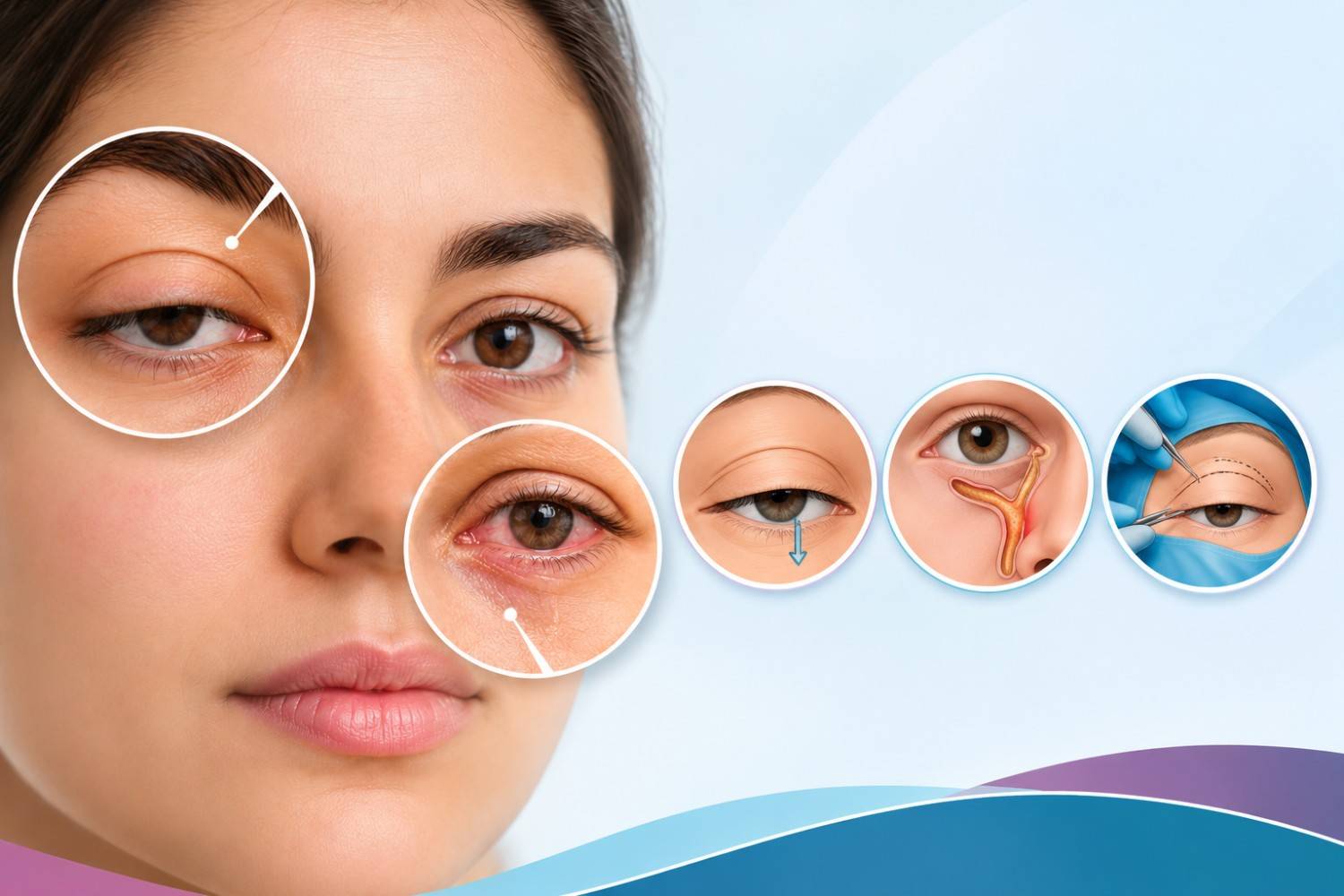
Droopy Eyelids and Blocked Tear Ducts: Causes, Symptoms and Treatment Options
|
Key
takeaways •
Droopy eyelid (ptosis) means the upper eyelid sits too low. Mild,
stable cases may only need monitoring. Surgery is the most common treatment
when vision or daily life is affected. •
A blocked tear duct stops tears draining into the nose, so the eye
waters constantly. Many babies' blockages clear on their own in the first
year, while adults often need a procedure. •
Sudden drooping with double vision, a changed pupil, weakness or
severe headache is an emergency. •
Oculoplasty is the area of ophthalmology that deals with the eyelids,
orbit, tear drainage system and surrounding tissues. |
Your eyelids
protect the surface of the eye, spread tears with every blink and help you see
comfortably. When an eyelid droops, turns in or out, or the tears cannot drain,
the problem can affect how your eyes feel, how they work and how they look.
This guide explains two common concerns, droopy eyelids and blocked tear ducts,
covering causes, symptoms, treatment options and when to seek urgent care.
It is general
education and cannot diagnose your eyes. If you live in Vadodara, you will also
find what an oculoplasty consultation at Sattva Eye Hospital involves.
What Is Oculoplasty?
Oculoplasty is
a specialised area of ophthalmology that deals with the eyelids, the orbit (the
bony socket of the eye), the tear drainage system and the tissues around the
eyes. Problems here can be functional, cosmetic, congenital, age-related or the
result of injury, and they do not always look like an eye problem at first. A
drooping eyelid may seem like tiredness, and an eyelid that turns inward may
first feel like irritation.
Oculoplasty is
not only cosmetic. Many eyelid conditions need treatment to improve eyelid
function, protect the eye or address vision-related problems.
What Is a Droopy Eyelid (Ptosis)?
Ptosis is the
medical term for a drooping upper eyelid. It can affect one or both eyes, be
present from birth or develop later, and range from mild to severe. In severe
cases the lid covers part of the pupil and blocks vision.
Causes of ptosis
•
Ageing: the muscle or tendon that lifts the lid
can stretch over time. This is the most common cause in adults.
•
Congenital: the lid-lifting muscle develops
weakly, so the droop is present from birth.
•
Injury or previous eye surgery affecting the
muscle or its nerve.
•
Muscle or nerve conditions, and sometimes
growths in or around the eyelid or eye socket.
Some eyes only
look as if the lid is drooping because of excess eyelid skin hanging over it.
An examination tells the two apart.
Symptoms of ptosis
•
The affected eye looks smaller or more tired, and the
normal fold above the lid may be lost.
•
Part of the upper field of vision is blocked, so you
may tilt your head back or raise your eyebrows to see.
•
Eyebrow or forehead strain, or a heavy feeling in the
lids.
In children, a
low lid can block vision and affect how vision develops, so a child with ptosis
needs prompt evaluation.
How ptosis is assessed
The doctor
measures eyelid height and the strength of the lid muscle, checks eye movements
and pupils, and examines the surface of the eye. If a nerve or muscle condition
is suspected, further tests may be needed, because the aim is also to identify
causes that threaten vision or health (StatPearls). Sattva
Eye Hospital lists neuro-ophthalmology
for vision problems related to the optic nerve, brain and neurological
pathways. The eye surface matters because lifting the lid can affect how well
the eye stays moist and protected.
Treatment options for ptosis
•
Monitoring: mild ptosis that is stable and does
not affect vision may need no treatment.
•
Treating the cause: if a muscle, nerve or eyelid
problem is responsible, treating it can improve the droop or stop it getting
worse.
•
Non-surgical options: in selected adults,
prescription eye drops that lift the lid slightly, or special spectacle frames
with a lid crutch, may help (Harvard
Health).
•
Surgery: the most common treatment when ptosis
affects vision or daily life. The surgeon tightens or repositions the
lid-lifting muscle, or in severe cases connects the lid to the forehead muscle.
The method depends on the cause, the severity and how well the lid muscle
works.
For most people
with age-related ptosis, and for children with congenital ptosis, surgery can
correct the droop. Your surgeon will explain the expected result and risks for
your eyes.
What Is a Blocked Tear Duct?
Tears drain
through tiny openings at the inner corners of the eyelids, along small channels
into the tear sac, and down the nasolacrimal duct into the nose. If any part of
this pathway is blocked, tears back up and overflow. This is called
nasolacrimal duct obstruction, or a blocked tear duct.
Symptoms of a blocked tear duct
•
Constant watering, with tears running onto the lashes
and cheek.
•
Sticky or mucky discharge, and crusting on the lashes.
•
Redness, and repeated eye infections.
•
Swelling at the inner corner of the eye.
These symptoms
are not specific and can look like conjunctivitis, dry eye or allergy. An
outward-turning eyelid (ectropion) can also cause watering. An examination is
needed to find the cause. A blocked tear duct can raise the risk of eye
infection, so see a doctor if watering is persistent, or if pain, redness or
swelling develops.
Causes
•
Babies: a thin membrane at the end of the tear
duct has not opened yet. It usually opens on its own during the first year.
•
Adults: age-related narrowing, past infection or
inflammation, injury, and sometimes a growth, which is uncommon.
Treatment options for a blocked tear duct
•
Babies: many improve on their own. Doctors may
teach parents gentle massage over the tear sac. If watering persists beyond the
first year, a brief probing and irrigation procedure is usually considered (AAO).
•
Adults, mild or partial blockage: observation,
massage and, if there is infection, treatment of the infection. A partial
blockage or narrowing of the drainage opening may be widened with dilation,
probing and irrigation (AAO).
•
Adults, persistent blockage: surgery is usually
the preferred option. Dacryocystorhinostomy (DCR) creates a new drainage route
from the tear sac into the nose, and is the procedure most often used for
blocked tear ducts in adults (AAO,
Mayo
Clinic).
The right
option depends on age, the cause and where the blockage lies, and not every eye
centre offers every procedure.
Other Eyelid Problems That Oculoplasty Covers
•
Entropion: the eyelid turns inward, so the
lashes rub the eye and cause irritation.
•
Ectropion: the eyelid turns outward, which can
cause watering, irritation or exposure of the eye surface.
•
Eyelid lesions: growths on or around the lid
that need careful clinical evaluation.
•
Eyelid injuries and congenital eyelid conditions,
which may need functional or reconstructive care.
What Happens at an Oculoplasty Consultation?
At Sattva Eye
Hospital, an oculoplasty consultation follows a structured sequence:
•
Medical history: your symptoms, earlier
treatments, surgeries and relevant health conditions.
•
Eyelid assessment: eyelid position, movement,
symmetry and function.
•
Ocular surface examination: how the eyelids
affect the moisture, comfort and protection of the eye.
•
Eye examination: a complete ophthalmic
assessment when clinically appropriate. Sattva also lists a comprehensive
eye examination service.
•
Functional assessment: whether the problem
affects vision, comfort, eye protection or daily visual function.
•
Treatment planning: a discussion of medical,
functional, reconstructive or cosmetic options suited to you.
Oculoplasty in Vadodara: When to See an Eye Doctor
Seek urgent
care if you have sudden drooping with the warning signs above, or a painful
swollen red area at the inner corner of the eye with fever. Go to the nearest
hospital emergency department instead of waiting for a routine appointment.
Book a
consultation if a lid droops or sits abnormally, if an eyelid turns in or
out, if one eye waters constantly, if you notice an eyelid growth, or if your
child has a drooping lid or persistent watering.
Sattva Eye
Hospital's oculoplasty
and eyelid care page lists drooping eyelids, inward and outward turning
eyelids, eyelid injuries and reconstruction, congenital eyelid conditions,
age-related eyelid changes, and lacrimal and periocular conditions among the
concerns its oculoplasty care may address. Treatment may involve medical
management, a functional eyelid procedure, reconstructive surgery or cosmetic
correction, depending on the diagnosis. For children, see its pediatric eye care
page.
Frequently Asked Questions
What is oculoplasty?
Oculoplasty is
a specialised area of ophthalmology dealing with the eyelids, the orbit, the
tear drainage system and the tissues around the eyes.
Is oculoplasty only for cosmetic reasons?
No. It includes
functional and cosmetic procedures. Many eyelid conditions need treatment to
improve eyelid function, protect the eye or address vision-related problems.
Does a droopy eyelid always need surgery?
No. Mild,
stable ptosis that does not affect vision may only need monitoring. Surgery is
the most common treatment when the droop affects vision or daily life.
Can a droopy eyelid affect vision?
Yes. In
moderate to severe cases the lid can cover part of the pupil and block the
upper field of vision. In children it can affect how vision develops.
When is a droopy eyelid an emergency?
When it appears
suddenly, especially with double vision, a changed pupil, weakness, a drooping
face, trouble speaking, severe headache or eye pain. Go to a hospital emergency
department.
What causes a blocked tear duct?
In babies, a
membrane at the end of the tear duct that has not yet opened. In adults,
age-related narrowing, past infection or inflammation, injury, or rarely a
growth.
Will a baby's blocked tear duct clear on its own?
Often, yes.
Many blockages open during the first year, and doctors may suggest gentle
massage. If watering persists beyond the first year, probing is usually
considered.
How is a blocked tear duct treated in adults?
Mild or partial
blockages may be managed with observation, massage, treatment of infection, or
widening of the duct. A persistent blockage is usually treated with
dacryocystorhinostomy, which creates a new drainage route into the nose.
How do I book an oculoplasty consultation at Sattva Eye Hospital?
Use the online
appointment page or call +91 75760 82474. The team will help schedule a
consultation at a convenient time.
Conclusion
A drooping
eyelid or a constantly watering eye is more than a cosmetic nuisance. Both can
affect comfort, protection of the eye and sometimes vision, and the cause
decides the treatment. Mild cases may only need monitoring, while others need a
procedure. Sudden drooping with other symptoms is an emergency. If you are in
Vadodara and have an eyelid or tear drainage concern, you can learn more about oculoplasty
and eyelid care at Sattva Eye Hospital or book an evaluation.