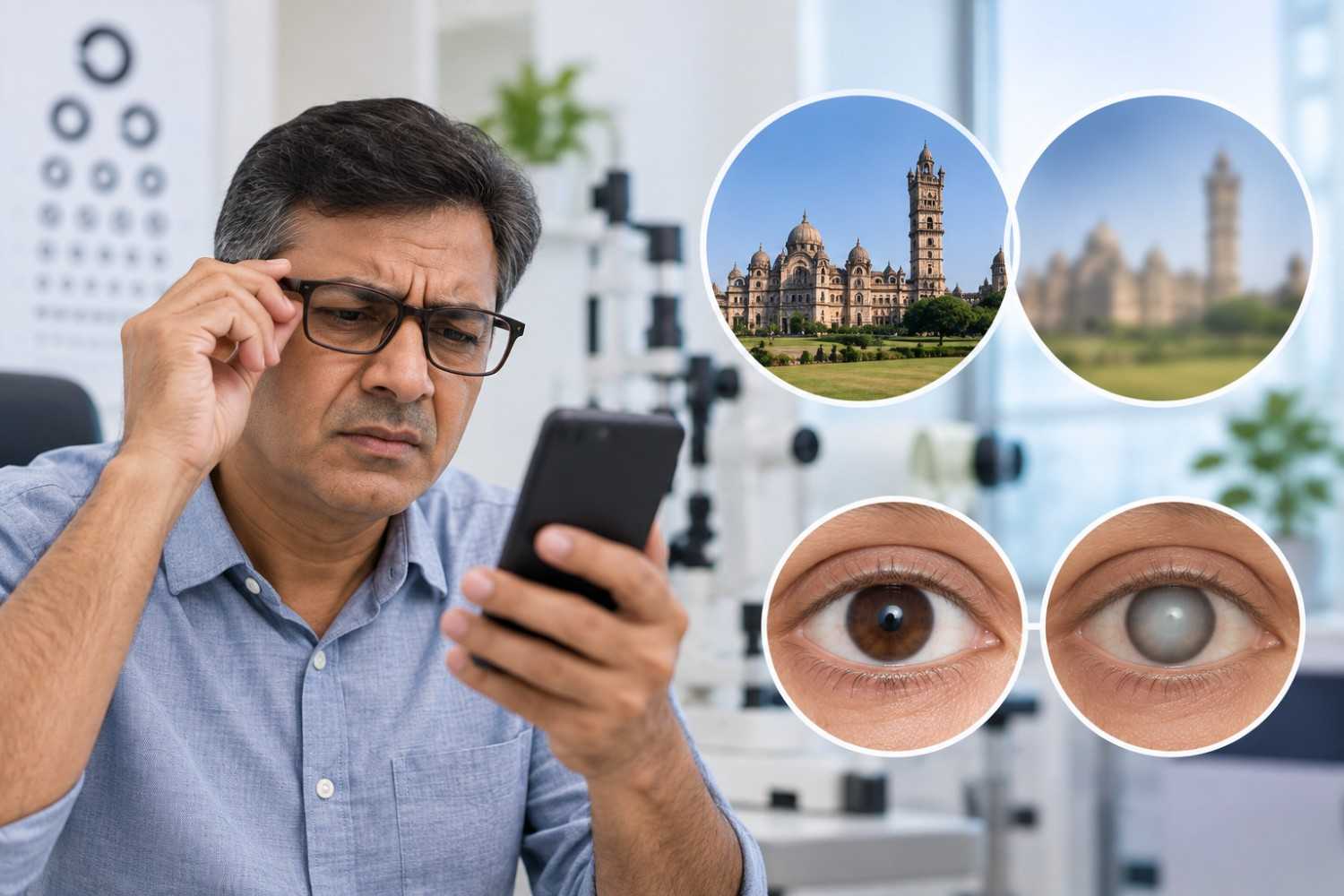
Blurry Vision After 40 in Vadodara: Is It Cataract or Something Else?
Somewhere around 40, most people notice the same small change. The
restaurant menu drifts a little farther from the face, the phone gets held at
arm's length, and reading in dim light suddenly takes more effort than it used
to. It is tempting to file this under “cataract starting,” but that assumption
is usually wrong — and being wrong about it can work against you both ways.
Some people spend years assuming nothing can be done about blur that reading
glasses would fix in a week. Others dismiss a genuine early cataract, a
glaucoma change, or a retinal problem as “just age” and delay the checkup that
would have caught it.
This guide separates presbyopia — the near-universal focusing change
that begins in the 40s — from the handful of conditions, cataract included,
that can feel similar at first but call for a different response. It also
explains what a comprehensive eye examination actually checks for, and which
symptoms in Vadodara's heat and dust should not wait for a routine appointment.
The Short Answer: It's Usually Presbyopia, But Not Always
Blurry vision after 40 is most often presbyopia — a normal, expected
decline in the eye's ability to focus up close, not a disease of the eye
itself. But the same age bracket is also when cataract, glaucoma, diabetic eye
changes, dry eye, and shifts in refractive error start becoming more common.
Several of these feel remarkably alike from the inside: things look a little
softer, a little duller, a little harder to make out. A comprehensive eye
examination is the only reliable way to tell them apart, because it looks at
what is actually happening inside the eye rather than relying on how the blur
feels.
Presbyopia: The Change Almost Everyone Notices First
Presbyopia happens because the eye's natural lens gradually loses the
flexibility it needs to change shape for close-up focusing. The lens itself
usually stays clear; it is the focusing mechanism, not the lens's transparency,
that is affected. This is why presbyopia has a fairly specific signature: near
vision blurs while distance vision generally stays sharp, the change is gradual
and predictable rather than sudden, and it is corrected effectively with
reading glasses, bifocals, or progressive lenses. It does not threaten eye
health and it does not progress toward vision loss — it is simply the eye's
optics doing what optics do with age. Most people notice it first in their
mid-to-late 40s, though the exact timing varies.
Is It Cataract? The Signs That Point This Way
A cataract is a clouding of the eye's natural lens, and unlike
presbyopia, it affects both near and distance vision because the problem is the
clarity of the lens, not just its flexibility. The change is usually gradual,
often unfolding over months to years, which is exactly why it gets mislabeled
as ordinary aging. Signs that suggest cataract rather than simple presbyopia
include:
- Blurred or
hazy vision that affects distance as well as near vision, not just close-up tasks.
- Colors
looking faded or less vivid than they
used to, even in good light.
- Increased
glare or halos around headlights that
make night driving noticeably harder.
- Repeated
changes in glasses prescription over
a short period, without a clear reason.
- Needing
progressively brighter light for reading or other close-up tasks.
- Double vision
noticed in one eye specifically,
rather than both.
Cataracts most commonly become visually significant from the 50s
onward, but they can appear earlier in people with diabetes, a history of eye
injury, long-term steroid use, high myopia, or a family history of early
cataract. Age alone is not a reliable filter — the pattern of symptoms matters
more than the calendar.
Other Conditions That Get Mistaken for “Just Cataract”
A handful of other conditions become more common in the same decade
and can produce blur, dimness, or visual discomfort that feels similar to early
cataract. Distinguishing between them changes what happens next, so each
deserves its own explanation.
Glaucoma
Glaucoma is often described as a “silent” condition for good reason:
in its common, chronic form, it rarely causes blurred vision early on. Instead,
it damages the optic nerve gradually, starting with peripheral vision that most
people do not notice losing until a significant amount is already gone. This is
precisely why glaucoma is caught through routine intraocular pressure
measurement and optic nerve examination rather than by waiting for blur to
appear. The exception is acute angle-closure glaucoma, a much less common
emergency that causes sudden eye pain, redness, halos around lights, nausea,
and rapid vision loss — a presentation that needs same-day attention, not a
scheduled appointment.
Diabetic Retinopathy and Diabetic Macular Edema
In people with diabetes, chronically elevated blood sugar can damage
the small blood vessels feeding the retina, leading to leakage, swelling, or
abnormal vessel growth. When this affects the macula — the part of the retina
responsible for sharp, central vision — it produces blur that can fluctuate
along with blood sugar control rather than progressing in one smooth line.
Because early diabetic retinopathy frequently causes no symptoms at all, a
dilated retinal examination is the standard way to detect it, independent of
whether vision feels blurred.
Age-Related Macular Degeneration
Macular degeneration typically becomes relevant somewhat later,
generally from the 50s onward, though it is worth knowing about in this age
bracket because early risk factors — smoking, family history, and cumulative
sun exposure among them — are already in motion by 40. When it does occur, it
tends to affect central vision specifically: straight lines may appear wavy or
bent, and a blurred or blank patch can develop in the center of the visual
field while peripheral vision stays intact.
Dry Eye and Ocular Surface Strain
Dry eye produces a different pattern of blur — one that fluctuates
through the day and often clears, at least briefly, with blinking. It is
extremely common in Vadodara's hot, dusty months and in air-conditioned
offices, and it is frequently made worse by long stretches of screen use, which
reduces the natural blink rate. Unlike cataract or retinal disease,
dry-eye-related blur is not a sign of structural damage to the eye, though
persistent or worsening dry eye still deserves proper evaluation and treatment.
Uncorrected or Shifting Refractive Error
Short-sightedness, long-sightedness, and astigmatism do not disappear
after 40 — in fact, the eye's overall refractive balance can shift with age
even in people who never needed glasses before. This kind of blur corrects
essentially instantly with the right prescription, which is one reason a full
refraction is a standard part of ruling out other causes.
Quick Comparison: Common Causes of Blurry Vision After 40
|
Condition |
Typical Pattern |
Distinctive Sign |
What Is Affected First |
|
Presbyopia |
Gradual,
from the 40s onward |
Holding
things farther away to focus |
Near
vision only |
|
Cataract |
Gradual,
often 50s onward (can be earlier) |
Glare
or halos at night, faded colors |
Both
near and distance vision |
|
Glaucoma
(chronic) |
Slow,
often unnoticed for years |
Peripheral
vision loss, usually painless |
Side
vision, then central vision |
|
Diabetic
retinopathy |
Any age
with diabetes; may fluctuate |
Blur
that tracks with blood sugar control |
Central
vision, if the macula is involved |
|
Dry eye |
Fluctuates
through the day |
Clears,
at least briefly, with blinking |
Comfort
and visual clarity, not eye structure |
|
Refractive
error shift |
Can
appear at any age |
Corrected
almost instantly by the right glasses |
Near or
distance vision, depending on the type |
Why Vadodara's Climate and Daily Habits Matter
Local context genuinely changes the picture here, and not just as a
matter of geography. Cumulative ultraviolet exposure over a lifetime is a recognised,
modifiable risk factor for cataract, and Vadodara's long, intense summer means
more UV exposure for anyone who spends meaningful time outdoors without eye
protection — a point in favour of UV-blocking sunglasses as routine wear, not
an occasional accessory. Separately, the combination of heat, dust, and heavy
air-conditioning use common across Vadodara offices and homes is a well-known
driver of evaporative dry eye, which can mimic the fluctuating blur described
above without being related to cataract, glaucoma, or the retina at all.
Extended screen time compounds this by reducing the blink rate. None of this
changes a genuine cataract or retinal finding, but it does mean that a meaningful
share of “blurry after 40” complaints in this climate turn out to be ocular
surface issues that respond well to straightforward treatment once identified
correctly.
What a Comprehensive Eye Checkup Actually Tests
A comprehensive eye examination is built to sort through exactly this
list, rather than guess based on symptoms alone. It typically includes:
- Visual acuity
testing and refraction to measure
how clearly you see and whether glasses need updating.
- Slit-lamp
examination of the lens to check for
early cataract changes.
- Intraocular
pressure measurement and optic
nerve assessment to screen for glaucoma.
- A dilated
fundus examination to examine
the retina, macula, and optic nerve directly.
- OCT imaging
when indicated, providing a detailed
cross-sectional view of retinal and optic nerve structure.
Because several of these findings — particularly early glaucoma and
early diabetic retinopathy — produce no symptoms at all in their early stages,
a routine comprehensive eye examination is the recommended way to check for
them rather than waiting for a visible change in vision.
When Not to Wait for a Scheduled Appointment
Most of the changes described above are gradual and can reasonably
wait for a routine booking. A smaller set of symptoms should prompt evaluation
right away rather than at the next convenient slot:
- Sudden loss
of vision in one or both eyes
- A sudden
shower of new floaters, flashes of light, or a shadow or curtain moving across
the vision
- Severe eye
pain combined with redness, halos around lights, nausea, or headache
- Sudden double
vision
These patterns can indicate conditions such as retinal detachment or
acute angle-closure glaucoma, where the time between symptom onset and
treatment genuinely affects the outcome.
FAQ
Can cataract and
presbyopia happen at the same time?
Yes, and it is common. Presbyopia typically begins in the mid-40s,
while cataract changes often start becoming visually significant in the 50s and
60s, so there is a real window where both are present together. An eye
examination can separate what each condition is contributing to the blur.
Does blurry vision after
40 always mean I need new glasses?
Not necessarily. It could reflect presbyopia, a genuine change in
refractive error, early cataract, dry eye, or a retinal issue. A comprehensive
eye examination is the way to determine which of these applies before assuming
glasses alone will solve it.
Can cataracts develop
before age 50?
Yes. While cataract is more common from the 50s onward, it can appear
earlier in people with diabetes, a history of eye injury, long-term steroid
use, high myopia, or a family history of early cataract.
Is glaucoma likely to
cause blurry vision?
Usually not in its early stages. Chronic glaucoma tends to affect
peripheral vision first and often produces no noticeable blur until damage is
advanced, which is why intraocular pressure checks and optic nerve evaluation
matter more than waiting for symptoms.
How often should I get my
eyes checked after 40?
An annual comprehensive eye examination is a reasonable baseline for
most adults after 40. People with diabetes, high blood pressure, or an existing
eye condition are often advised to follow a more frequent schedule set by their
ophthalmologist.
Can diet or eye exercises
reverse presbyopia or cataract?
No reliable evidence supports reversing either condition through diet
or eye exercises. Presbyopia is managed with corrective lenses, and a cataract
that is affecting daily activities is treated by surgically removing the
clouded lens and replacing it with an artificial one.