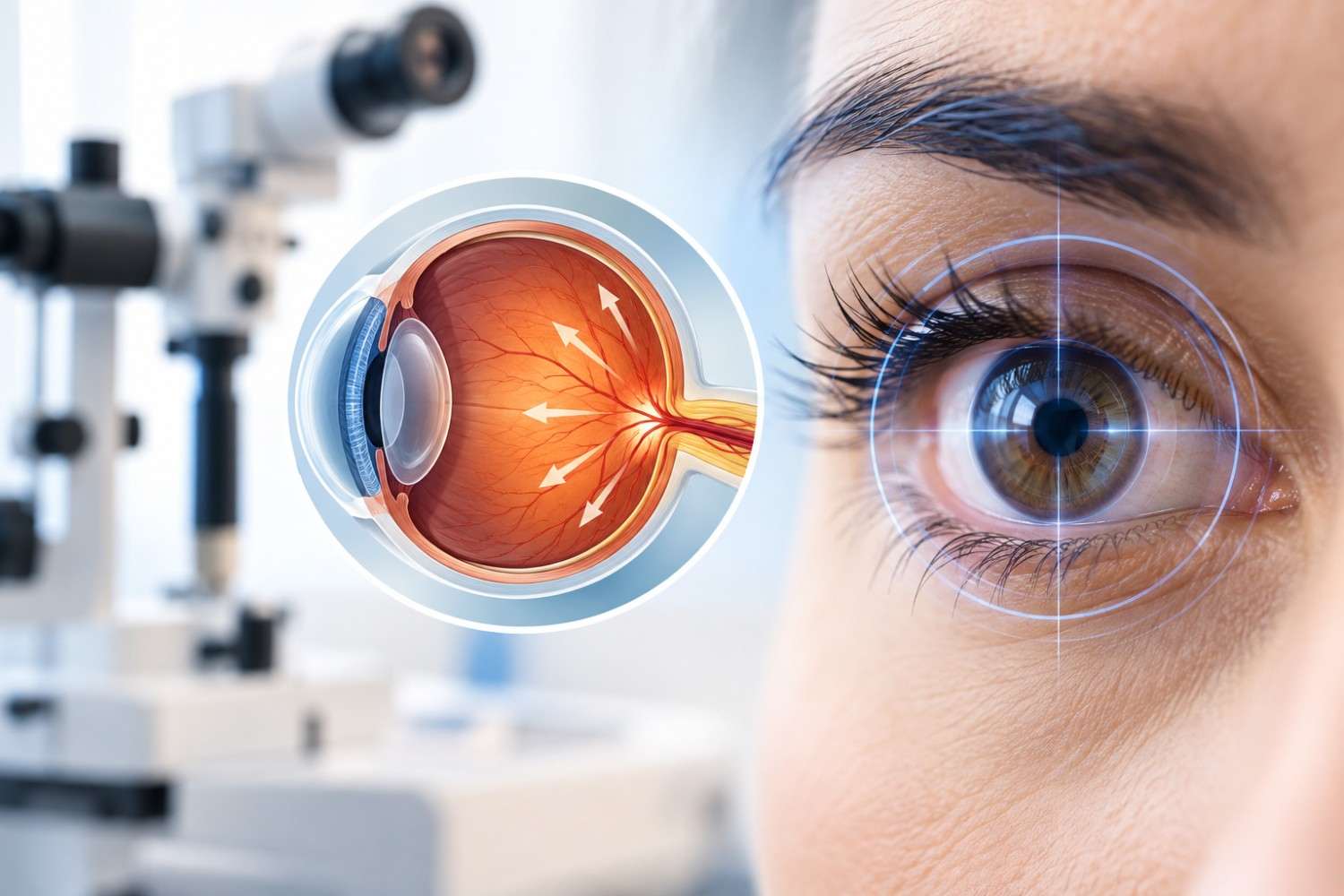
What Glaucoma Actually Does to the Eye
Glaucoma is not a single disease
but a group of conditions that damage the optic nerve, the cable that carries
visual information from the eye to the brain. In most cases, this damage is
linked to elevated pressure inside the eye (intraocular pressure), which builds
up when the eye's internal drainage system does not function efficiently. As
nerve fibres are damaged, the field of vision narrows — usually starting at the
edges and moving inward, long before central, straight-ahead vision is
affected.
This pattern is exactly why
glaucoma is so easy to miss. Human vision relies heavily on central sight for
reading, recognising faces and everyday tasks, so a slow loss at the periphery
can go unnoticed for years, especially since the brain instinctively fills in
the missing parts of the picture.
Why the Early Signs Are So Easy to Miss
Unlike a scratched cornea or an
infection, glaucoma typically does not hurt. Vision remains sharp for near and
far tasks well into the disease's progression in the most common form, primary
open-angle glaucoma. Peripheral vision loss develops so gradually that many
patients only discover it when they miss a car approaching from the side,
misjudge a step, or fail a peripheral vision test during an unrelated eye exam.
This is why regular pressure checks and optic nerve evaluations matter more
than waiting for symptoms.
Subtle Warning Signs Worth Paying Attention To
While early open-angle glaucoma
is often symptom-free, a number of subtle changes are worth discussing with an
eye specialist rather than dismissing as normal ageing:
- Gradually bumping into objects or people on one side,
or noticing you're missing things at the edge of your vision
- Needing to turn your head more than before to see
things to the side while driving
- Seeing coloured halos or rings around lights,
particularly at night
- Occasional eye discomfort, a dull ache, or a feeling of
pressure in one eye
- Frequent, unexplained changes to your spectacle
prescription
- Difficulty adjusting to dim lighting or low-contrast
environments
A separate, much more dramatic
pattern applies to acute angle-closure glaucoma, a less common but urgent form.
This presents with sudden severe eye pain, redness, blurred vision, halos
around lights, headache, and sometimes nausea or vomiting. This combination is
an eye emergency and needs same-day care, unlike the slow-developing open-angle
form.
Open-Angle vs Angle-Closure Glaucoma: Key Differences
|
Feature |
Open-Angle Glaucoma |
Angle-Closure Glaucoma |
|
Onset |
Slow,
over months to years |
Can be
sudden (acute attack) or gradual (chronic form) |
|
Pain |
Typically
none |
Severe
pain in the acute form |
|
Early
symptoms |
Usually
none; peripheral vision loss unnoticed |
Acute
form: redness, halos, headache, nausea |
|
Urgency |
Routine
evaluation and monitoring |
Acute
form is a same-day eye emergency |
|
Detection |
Eye
pressure check, optic nerve exam, visual field test |
Same
tests, plus gonioscopy to assess the drainage angle |
Who Is Most at Risk in Vadodara
While anyone can develop
glaucoma, certain factors raise the risk meaningfully and warrant closer, more
frequent monitoring:
- Age over 40, with risk increasing further after 60
- A parent or sibling with glaucoma
- Diabetes or high blood pressure
- High myopia (significant short-sightedness)
- Prolonged use of steroid medications, including steroid
eye drops
- A previous eye injury
- Thin corneas, identified during a comprehensive eye
exam
How Glaucoma Is Actually Diagnosed
Because symptoms are unreliable,
diagnosis depends on a structured set of tests rather than how your vision
feels day to day:
- Tonometry — measuring intraocular pressure, usually
with non-contact tonometry as a first step
- Gonioscopy — examining the drainage angle of the eye to
classify the type of glaucoma and rule out angle closure
- Optic nerve evaluation — a detailed look at the optic
nerve head, often supported by OCT imaging to detect subtle structural changes
before visible vision loss occurs
- Visual field testing (perimetry) — mapping out the full
field of vision to detect and monitor peripheral vision loss
- Pachymetry — measuring corneal thickness, which affects
how eye pressure readings should be interpreted
None of these tests are painful,
and together they build a complete picture that a pressure reading alone cannot
provide. This is also why an eye pressure check at a general health camp is a
screening step, not a substitute for a full glaucoma evaluation.
Why Choose Sattva Eye Hospital for Glaucoma Care in Vadodara
Glaucoma management is a
long-term relationship, not a one-time visit, which makes the choice of
specialist and facility genuinely important. At Sattva Eye Hospital in
Vadodara, glaucoma evaluation and management is led by Dr. Ankit Ahir (MBBS,
DOMS, DNB Ophthalmology, MNAMS), who trained at the M & J Institute of
Ophthalmology in Ahmedabad — one of India's leading government eye institutes —
and gained further advanced clinical experience at Sri Sankaradeva Nethralaya
in Guwahati.
What this means in practice for
a glaucoma patient is a full diagnostic workup — including intraocular pressure
measurement, gonioscopy, and visual field testing — under one roof, combined
with a clear, plain-language explanation of your specific risk category, rather
than a quick prescription handed over without context. Because glaucoma
requires monitoring at regular intervals, continuity of care with the same
specialist, using the same equipment and consistent measurement technique, also
makes it easier to track whether the disease is stable or progressing over
time.
FAQ
Can glaucoma be cured?
No. Glaucoma cannot be reversed,
and any vision already lost to it cannot be restored, but it can almost always
be controlled. With timely diagnosis and consistent treatment, most people with
glaucoma keep useful vision for life.
Does high eye pressure
always mean glaucoma?
Not necessarily. Some people
have elevated eye pressure without any optic nerve damage (ocular
hypertension), while others develop glaucoma with pressure in the statistically
normal range (normal-tension glaucoma). This is why a full evaluation, not a pressure
reading alone, is needed to diagnose it.
At what age should
glaucoma screening start?
General screening is usually
recommended from around age 40, and earlier if you have a family history of
glaucoma, diabetes, high myopia, or have previously used steroid medication for
a prolonged period.
Is glaucoma
hereditary?
Having a parent or sibling with
glaucoma raises your own risk meaningfully, which is why family history is one
of the first questions asked during a glaucoma evaluation.
Is glaucoma surgery
always required?
No. Many cases are managed for
years with pressure-lowering eye drops alone. Laser treatment or surgery is
usually reserved for cases where drops are insufficient, not tolerated, or the
glaucoma is progressing despite medical treatment.